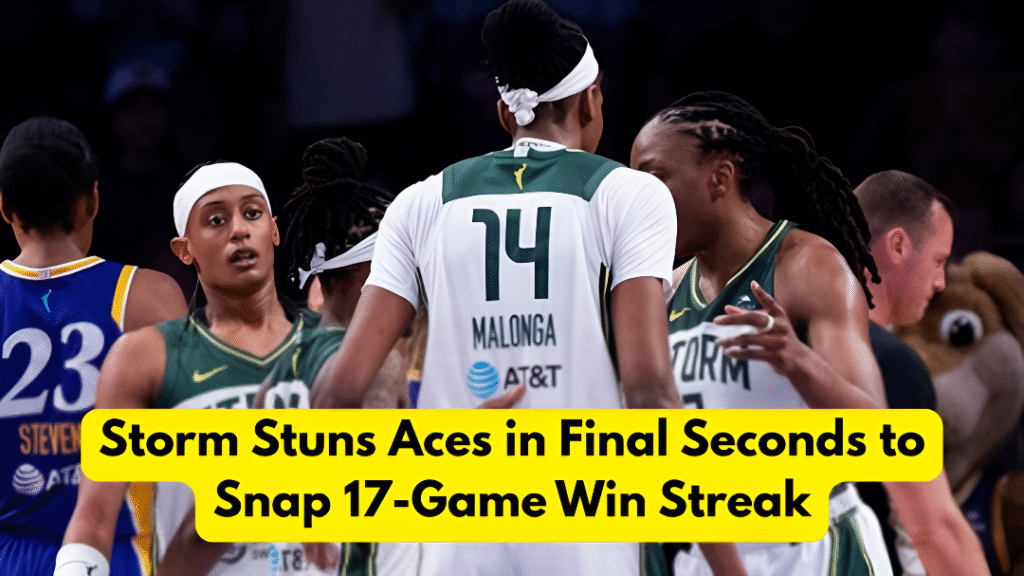
Let’s break down what actually went on at Climate Pledge Arena, because that building might as well have had a Richter scale out front Tuesday night. The sold-out crowd—12,500 deep—generated a sustained level of audible energy that did not dip until the final buzzer. Objectively, the atmosphere can only be described as electric. The scenario: Seattle Storm, trailing by as much as a dozen in Q4, manage to erase the deficit and close out a game that objectively qualifies as a high-stress, high-leverage playoff contest, defeating the Las Vegas Aces 86-83 in Game 2 of the WNBA semifinals.
Let’s dissect Skylar Diggins’ response to the situation—“We bought ourselves 40 more minutes.” In technical terms, her articulation acknowledges the survival imperative of the playoffs: you win or you’re done, and every extra game is an extension of the season’s operational window. Her follow-up—starting their own streak—implies not just a desire for isolated victories but the initiation of a competitive feedback loop, shifting momentum.
Quantitatively, Seattle put an abrupt halt to the Aces’ 17-game win streak, which itself was one of the defining performance metrics of the WNBA season. This sets up a pivotal Game 3 in Las Vegas, situationally increasing the stakes. The game climaxed with Diggins nailing a contested jumper over the defensive pressure of Jackie Young, timed at 4.4 seconds on the game clock. The Aces’ terminal possession—capped by Jewell Loyd’s three-point miss as time expired—eliminated any possibility for a counteraction, sealing the outcome.
Statistical performance deserves precise attribution. Nneka Ogwumike, muted in Game 1, re-emerged with a 24-point effort (efficient 9-for-19 field goals), supplementing with 10 rebounds and three assists—a bona fide double-double under playoff pressure. Diggins was the lead variable with 26 points, supplemented by seven assists and two steals, representing two-way impact. The Storm’s energy profile this game diverged significantly from Sunday’s 102-77 blowout, a match defined by a disastrous 17-5 start, from which the team never regained equilibrium.
Consider crowd dynamics—visually, a majority in uniform white promotional T-shirts, aligning with standard playoff marketing but signaling a coordinated fan presence. Seattle initially established a 13-9 lead midway through the first quarter, suggesting quick adaptation, but ended the opening period narrowly behind at 22-21, emphasizing volatility in game flow.
Diggins’ postgame analysis can be construed as a technical breakdown of strategic intent: passive versus active play initiation, the requirement for poise and resistance, and the need to suppress psychological momentum swings (“can’t let the moment be too big”). She identifies rapid acclimatization as critical—quelling nerves, recalibrating focus, and emphasizing intra-squad improvement channels.
From a scoring dynamics standpoint, Seattle’s pace in the second quarter (matching Vegas’ 23 points) ensured a competitive posture at halftime, trailing by a mere point (45-44). This statistical parity at the half sets the stage for a second half where marginal advantages—execution, composure, energy management—become dispositive.
Also Read: Latest Trending News