The NBA has always sold itself as the cleanest, smartest, most progressive league in American sports. A league where stars are brands, contracts are transparent, and the rules apply equally to everyone. But every once in a while, a story comes along that shakes that image to its core. A story that makes fans stop and ask a dangerous question: what if the game isn’t as clean as we think? What if the money moves in ways we’re not supposed to see? And what if one of the quietest superstars in NBA history is suddenly at the center of it all?
Kawhi Leonard has never been loud. He has never chased headlines. He has never begged for attention. No controversial tweets. No locker room leaks. No explosive interviews. Just championships, Finals MVPs, and a reputation as the most robotic, disciplined, business-like superstar the league has ever seen. That’s why this story feels so uncomfortable. Because when someone like Kawhi gets pulled into controversy, it doesn’t feel like noise. It feels like something real.
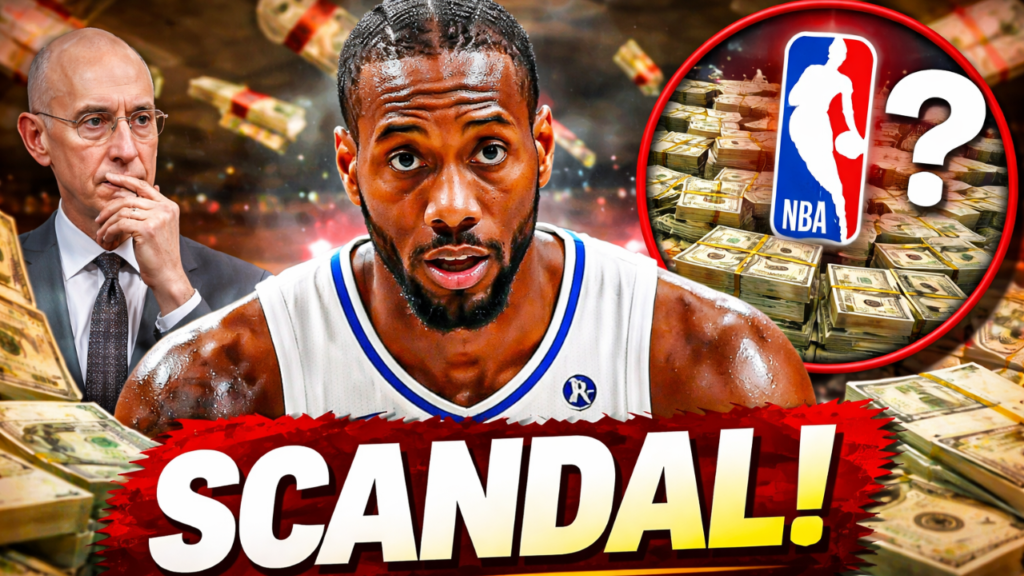
The controversy centers around a reported 28 million dollar deal that many fans are now calling a “no-show” agreement. On paper, it looks like an endorsement. A business partnership. Something NBA players sign all the time. But when you dig deeper, the questions start piling up fast. What exactly was Kawhi supposed to do for this money? How often did he appear? What value did the company receive? And most importantly, could this deal have been structured to quietly bypass NBA salary cap rules?
This is where things start getting messy. Because the NBA has strict limits on what teams can pay players. That’s the whole point of the salary cap — competitive balance. You can’t just hand your star extra money under the table. You can’t funnel payments through side channels. At least, you’re not supposed to. But history has shown us that where there are rules, there are always people trying to bend them.
Fans immediately began asking the obvious question: was this endorsement real, or was it a workaround? Was this truly about marketing value, or was it about keeping a superstar happy without it showing up on the books? And if this was allowed, how many other players are doing the same thing right now?
The silence from Kawhi’s camp only made things louder. No immediate denial. No emotional statement. No aggressive shutdown. Just quiet. The same quiet that has always followed Kawhi. But this time, the silence felt different. Because this time, the league itself reportedly started paying attention.
The NBA does not investigate lightly. When they do, it’s usually because something doesn’t add up. And when a league built on image, integrity, and betting partnerships starts sniffing around a deal like this, it tells you the implications could be massive. If the league determines that this deal was designed to manipulate the cap, the consequences wouldn’t just affect Kawhi. They could ripple across the Clippers organization, the endorsement world, and even future contract negotiations league-wide.
Think about what this means for competitive fairness. If one team can effectively pay a star more than the cap allows by using external business arrangements, then the entire system collapses. Small-market teams can’t compete. Teams that follow the rules get punished. And fans start wondering whether championships are bought in more ways than one.
Now imagine being a Clippers fan. For years, this franchise has been fighting the narrative that they’re cursed, dysfunctional, or second-class. They finally land Kawhi Leonard. They build around him. They sell a future. And now, suddenly, their franchise centerpiece is linked to a scandal that could stain everything they’ve been building toward.
But the other side of this story matters too. Because Kawhi Leonard is not the kind of player who needs secret deals to secure his legacy. He’s already done it. Two rings. Two Finals MVPs. One of the greatest playoff defenders ever. So why risk it? That’s the question fans can’t stop asking.
Some believe this is being blown out of proportion. That this was simply a poorly structured endorsement deal that looks suspicious because fans aren’t used to seeing the details. They argue that star athletes have complex business arrangements all the time, and that assuming wrongdoing just because a player is quiet is unfair. They point out that no official wrongdoing has been proven, and that speculation can destroy reputations faster than facts.
But others see a pattern. They see a league where stars increasingly control everything — rosters, coaching decisions, trade demands, load management. And now, possibly, compensation structures that operate in the shadows. To them, this story isn’t about Kawhi alone. It’s about how much power elite players truly have in today’s NBA.
The timing couldn’t be worse. The NBA is already walking a tightrope with sports betting partnerships. Fans are more skeptical than ever. Every questionable call, every injury rest night, every unexpected lineup decision gets scrutinized. Add a financial controversy involving one of the league’s biggest names, and suddenly trust becomes fragile.
What happens if the league finds wrongdoing? Fines would be the minimum. Draft picks could be at risk. Contracts could be re-examined. And the NBA would be forced to publicly admit that its system has loopholes big enough for millions of dollars to slip through. That’s not just a PR problem — that’s an existential one.
And what if Kawhi is cleared? Even then, the damage might already be done. Because once fans start asking questions, they don’t stop. Every endorsement deal gets re-evaluated. Every quiet superstar gets side-eyed. Every front office move gets framed as “what aren’t they telling us?”
This controversy also exposes something uncomfortable about modern NBA fandom. Fans love player empowerment — until it feels like players are more powerful than the league itself. We celebrate stars for taking control of their careers, but we panic when that control seems unchecked. This story sits right at that fault line.
And then there’s Kawhi the person. The man who avoids cameras. Who speaks in short sentences. Who treats basketball like a job, not a show. That image worked perfectly when things were clean. But in controversy, silence gets interpreted as secrecy. Fair or not, that’s the reality.
Imagine if this were LeBron. Or KD. Or Steph. There would be press conferences, social media wars, insider leaks every hour. But with Kawhi, the mystery is part of the story. And mystery fuels virality. People fill in the gaps with their own theories. And those theories spread faster than facts.
This could change how endorsement deals are structured forever. The league may tighten rules. Players may lose flexibility. Companies may hesitate to partner in unconventional ways. All because one deal raised one question that no one can fully answer yet.
At its core, this isn’t just a scandal. It’s a stress test. A test of whether the NBA’s financial system is as strong as it claims. A test of whether star power has outgrown regulation. And a test of whether fans still believe the league is playing fair.
No matter how this ends, one thing is certain: the era of blind trust is over. Fans are watching closer. Asking harder questions. And demanding transparency in ways the league has never faced before.
And maybe that’s the real controversy. Not whether Kawhi Leonard did something wrong — but whether the NBA has allowed a system where something like this could even be possible.
Because once fans start believing the game behind the game matters more than what happens on the court, the league doesn’t just lose control of the narrative. It risks losing trust. And trust, once broken, is harder to repair than any torn ACL or blown playoff lead.
So the question now isn’t just what happens to Kawhi Leonard. The question is what happens to the NBA if this door stays open.
Also Read: Latest Trending News