The NBA has always sold one powerful promise to its fans: what you’re watching is real. Every crossover, every clutch shot, every injury, every win and loss is supposed to be earned on the hardwood. But what happens when that promise starts to crack? What happens when whispers turn into rumors, rumors turn into allegations, and allegations turn into something far darker? Today, we’re talking about a controversy that has sent shockwaves through the basketball world — a scandal so explosive that it threatens the very integrity of the NBA itself.
For years, sports betting and the NBA have walked hand in hand. Ads flood broadcasts, odds scroll across screens, and partnerships with betting companies are now normal. Fans were told this was progress, transparency, and modernization. But behind the scenes, something ugly may have been brewing. Something nobody wanted to believe. Something the league desperately hoped would never come to light.
It starts quietly, as most scandals do. A few strange betting patterns here. An unexpected performance there. A player who usually dominates suddenly looks passive. Shots rim out. Minutes disappear. And then there’s the injury — always the injury. Fans shrug it off at first. Players get hurt. It’s basketball. But gamblers notice things fans don’t. Algorithms notice things humans miss. And when millions of dollars start moving in the same direction at the same time, people start asking questions.
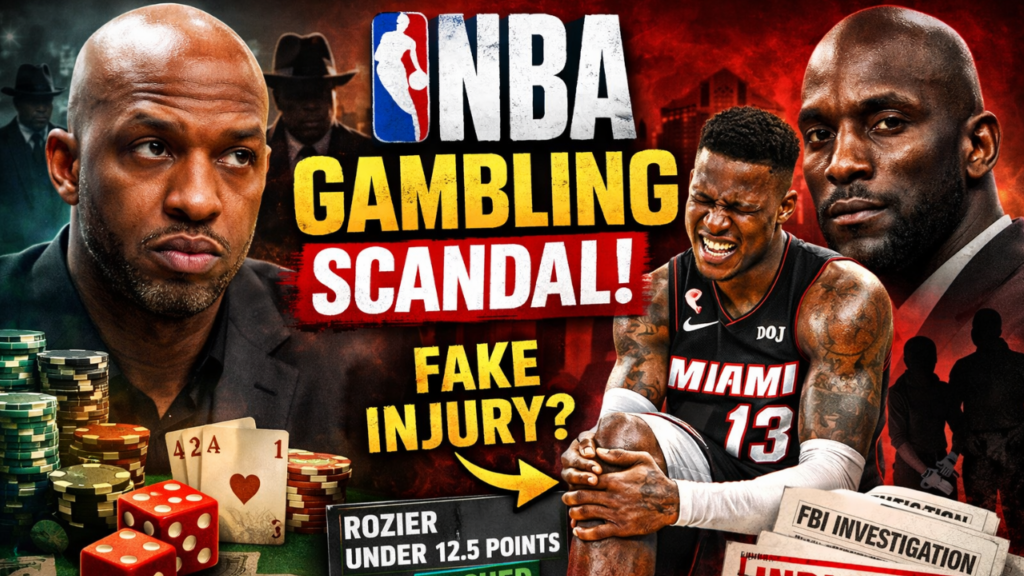
One name that sent shockwaves across social media was Terry Rozier. A respected veteran. A hard-nosed competitor. Not the type anyone would immediately suspect. But then the allegations surfaced — claims that certain betting lines around his performances showed impossible accuracy. Claims that insiders somehow knew when his minutes would drop, when his scoring would stall, when he wouldn’t finish games. And the most disturbing part? The timing. Everything allegedly lined up before the public ever knew anything was wrong.
According to what’s being whispered, this wasn’t random. This wasn’t coincidence. This was information — insider information — allegedly leaking into the gambling world. And if that’s true, then we’re not talking about one bad night or one bad bet. We’re talking about manipulation. We’re talking about outcomes being nudged, not by basketball skill, but by money.
As the spotlight widened, another bombshell hit. The involvement of high-profile figures, including coaches and former players. Names that fans grew up respecting. Names tied to championship legacies. Suddenly, stories emerged of underground poker games, private gambling circles, and connections that stretched far beyond a friendly night of cards. These weren’t casual games. These were high-stakes operations with enormous sums of cash changing hands.
And here’s where things get really uncomfortable. Organized gambling doesn’t survive on luck. It survives on control. On certainty. On knowing outcomes before they happen. Which raises a terrifying question: if bets were being placed with near-perfect accuracy, who was feeding that information? Players? Trainers? Staff? Or worse — people inside the system who were trusted to protect the game?
Fans began rewatching old games with fresh eyes. Clips resurfaced online. Missed layups. Strange substitutions. Players checking out early with injuries that didn’t look severe. Coaches making decisions that made no basketball sense. And suddenly, moments that once seemed forgettable now felt suspicious.
The NBA responded the way big institutions always do when faced with scandal — cautiously, slowly, and with carefully chosen words. “We take integrity seriously.” “We are cooperating with authorities.” “There is no evidence at this time.” But silence can be louder than words. And as days turned into weeks, fans noticed what wasn’t being said.
The league has spent decades building an image of trust after surviving some of the darkest chapters in sports history. From referee scandals to player controversies, the NBA knows how fragile credibility can be. That’s why this moment feels so dangerous. Because gambling isn’t on the outside anymore. It’s baked into the league’s business model. Which means if the integrity of games is questioned, the damage doesn’t stop at one player or one season. It spreads everywhere.
Social media exploded. NBA Twitter turned into a courtroom. Some fans defended players, arguing they’re being targeted unfairly in an era obsessed with betting. Others felt betrayed, saying the league sold out competition for profit. Former players weighed in. Analysts hinted without naming names. And gamblers — both professional and casual — demanded answers.
One of the most disturbing angles of this controversy is how normalized betting has become. Players are human. They hear the noise. They know the odds. They know prop bets exist on their points, rebounds, assists, even turnovers. When money is placed on individual performance rather than just wins and losses, temptation creeps in. You don’t have to throw a game to influence a bet. You just have to miss a few shots. Sit out a quarter. Take your foot off the gas.
That’s what makes this scandal so terrifying. If even a fraction of the allegations are true, it means manipulation can exist without fans ever noticing. The scoreboard might still look normal. The final result might not change. But the bets do. And in a world where billions are wagered every season, even small manipulations create massive profits.
As investigators reportedly dug deeper, the scope of the issue widened. This wasn’t about one team. Or one city. Or one locker room. It was about patterns across multiple games, multiple seasons, multiple players. The kind of patterns that don’t happen by accident.
And then came the most explosive rumor of all — that some injuries may not have been what they seemed. That certain “precautionary” sit-outs or mid-game exits conveniently aligned with betting outcomes. Now, to be clear, injuries are real and players put their bodies on the line every night. But when timing starts matching money, suspicion grows.
The NBA has always prided itself on being a player-driven league. Stars have power. Voices matter. But with power comes responsibility. And if even a small number of players abused that trust, the consequences could be historic. Suspensions. Lifetime bans. Federal charges. The kind of fallout that reshapes a league forever.
Sponsors are watching closely. So are broadcasters. So are regulators. Because this isn’t just about basketball anymore. It’s about whether professional sports can safely coexist with legalized gambling without crossing a line that can’t be uncrossed.
Fans feel stuck in the middle. They love the game. They love the players. But they also want honesty. They want to believe that when someone drops 40 points, it’s because they earned it — not because a betting line needed to be beaten or missed.
The league now faces an impossible balancing act. Admit too much, and risk collapsing public trust. Deny too much, and look like you’re hiding something. And as more details potentially emerge, the pressure will only grow.
This scandal could mark a turning point. Either the NBA comes out stronger, with stricter rules, transparency, and accountability — or it becomes the cautionary tale for every league flirting with gambling money.
One thing is certain: fans will never watch the game the same way again. Every missed free throw. Every unexpected benching. Every late injury report will be questioned. The innocence is gone.
The NBA wanted gambling to bring fans closer to the game. Instead, it may have pushed them into doubt.
And the scariest part? This might only be the beginning.
Because if this door has been opened once, how many others are waiting to be exposed?
Also Read: Latest Trending News