For years, Kawhi Leonard was known as the quiet one. No flashy quotes. No social media drama. No loud statements. Just basketball. Championships. Finals MVPs. A reputation built on silence, discipline, and professionalism. But sometimes, the quietest stars create the loudest explosions. And today, Kawhi Leonard’s name is no longer being whispered with respect — it’s being shouted with suspicion.
Because what is coming out now could shake the very foundation of how the NBA operates behind closed doors. Not a bad game. Not an injury. Not a locker-room fight. But something far more dangerous to the league’s image — money, power, and a deal that allegedly never required Kawhi Leonard to show up at all.
This story begins far away from the hardwood. No arenas. No practice gyms. No cameras. It begins in the world of private investments, luxury boardrooms, and billionaire-backed companies. A world where contracts are written in fine print, where appearances matter more than reality, and where millions of dollars can move hands without fans ever knowing.
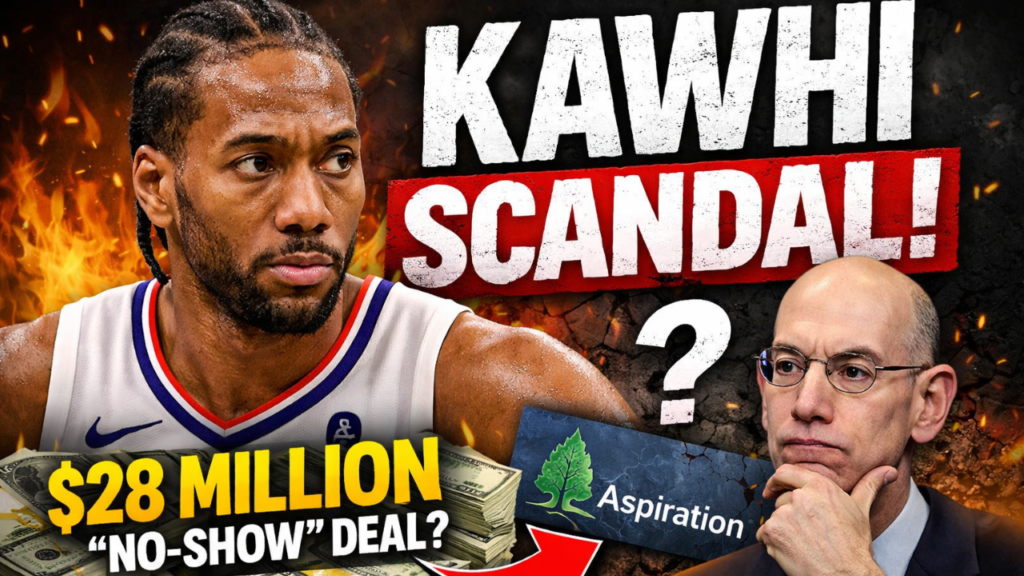
At the center of this storm is a company called Aspiration — once marketed as a revolutionary green investment firm, backed by celebrities and athletes, promising ethical finance and sustainability. On paper, it looked perfect. On paper, it was powerful. And on paper, Kawhi Leonard became one of its biggest celebrity partners.
But here’s where things turn dark.
Reports allege that Kawhi Leonard was promised a massive payout — around twenty-eight million dollars — for what was described as a sponsorship or advisory role. Sounds normal at first. NBA players endorse companies all the time. Shoes. Drinks. Crypto. Tech startups. But here’s the problem: investigators and critics are asking a simple question — what exactly did Kawhi Leonard do for that money?
No commercials. No public campaigns. No visible promotions. No active involvement. No clear work. No public appearances tied to the brand. And yet, the money was there. Waiting. Quietly. Privately.
That’s when the phrase that changed everything began circulating in league circles and online forums — “no-show job.”
A term that sends chills through any professional sports league.
Because a no-show job doesn’t mean a player is lazy. It suggests something far worse — a potential workaround. A hidden payment. A back-channel benefit. A way to move money without it counting where it should.
And in the NBA, where salary caps define competitive balance, where every dollar is regulated, tracked, and argued over, even the appearance of a workaround is explosive.
The allegation is not just about Kawhi Leonard. It’s about whether off-court business deals are being used as shadow contracts. Whether star players are receiving compensation that never touches the salary cap. Whether teams, sponsors, or third-party partners are quietly influencing player movement and loyalty.
And suddenly, Kawhi Leonard — the symbol of discipline and silence — is at the center of one of the most uncomfortable conversations the league has faced in years.
As news of the deal leaked, fans reacted instantly. Social media exploded. Some defended Kawhi, arguing that stars have earned the right to profit off their name however they choose. Others weren’t convinced. They asked why a company would pay tens of millions to an athlete who barely acknowledged its existence. They questioned whether this was really business — or something else entirely.
Then things got worse.
Aspiration reportedly began facing financial trouble. Layoffs. Legal complications. Bankruptcy whispers. And when the company’s internal records started surfacing, eyes went straight to one line item — the massive compensation package tied to Kawhi Leonard.
Now imagine this from the league’s perspective.
A superstar player, under a max contract, potentially receiving tens of millions more from a company with indirect ties to league interests. A deal with minimal visible obligations. A deal structured in a way that raises questions not just about ethics, but legality within NBA rules.
This is where Adam Silver enters the story.
The NBA commissioner is known for being calm, measured, and media-savvy. But behind that calm exterior is a league obsessed with control. Control of narrative. Control of money. Control of fairness. And nothing threatens that control like the idea that star players might be paid off the books.
Silver’s response was careful. No accusations. No conclusions. Just words like “review,” “process,” and “time.” But make no mistake — when the league says it’s looking into something, it means lawyers are involved. Accountants are involved. Contracts are being examined line by line.
Because if this turns out to be more than a poorly structured endorsement deal, the consequences could be massive.
We’re talking fines. Suspensions. Void contracts. Rule changes. And possibly opening a door the NBA has desperately tried to keep shut — public awareness of how business, influence, and power really work behind the scenes.
And this is where the story becomes bigger than Kawhi Leonard.
Because fans immediately began asking a terrifying question — if this happened once, how many times has it already happened?
How many stars have “advisory roles” that require nothing? How many investments are actually incentives? How many sponsorships quietly function as loyalty payments? How many decisions fans believe were about basketball were actually about money?
The NBA sells competition. It sells fairness. It sells the idea that championships are earned on the court. But allegations like this threaten to turn that image into fiction.
And for Kawhi Leonard, the timing could not be worse.
His career has already been shaped by injuries, load management debates, and questions about availability. Critics have long accused him of collecting massive paychecks while playing limited games. Fair or not, that narrative exists. And now, this controversy pours gasoline on it.
Fans are asking — if Kawhi barely plays, and now he’s allegedly being paid millions for work he didn’t do, what does that say about accountability?
Supporters argue that Kawhi owes nothing to anyone except the contracts he signed. That businesses make bad deals all the time. That endorsements don’t require public performance. That silence doesn’t equal guilt.
And they’re right — legally, nothing has been proven.
But perception matters. Especially in a league driven by public trust.
As the story spread, former players, analysts, and insiders began weighing in. Some dismissed it as media exaggeration. Others hinted that this kind of arrangement isn’t new — it’s just rarely exposed. And a few suggested that this investigation could be the beginning of something much larger.
Because if the NBA finds that endorsement deals are being used to bypass the salary cap, the league may be forced to rewrite its rules entirely. Third-party payments. Investment clauses. Advisory contracts. All under scrutiny.
And if that happens, every star contract becomes questionable.
Every move becomes suspicious.
Every championship becomes debatable.
For the Clippers, this is a nightmare scenario. A franchise already under pressure. A team built around Kawhi Leonard as the cornerstone. A city waiting for success. And now, potential league attention focused squarely on their biggest star.
For Kawhi himself, this may be the biggest test of his legacy.
Not because of basketball. But because of image.
Silence once protected him. Silence allowed him to avoid controversy. But in moments like this, silence becomes dangerous. Because when you don’t speak, others speak for you.
And right now, everyone is speaking.
Some are calling him a victim of corporate mismanagement. Others are calling him the face of a broken system. Some believe the league is overreacting. Others believe this investigation won’t go far enough.
But one thing is undeniable — this story refuses to disappear.
And it won’t disappear because it taps into something fans already fear. That the games they love are influenced by forces they’ll never see. That loyalty isn’t about cities or jerseys, but about balance sheets. That fairness might be more illusion than reality.
This is no longer just about a no-show job.
It’s about whether the NBA can truly claim competitive integrity in an era where money moves faster than rules.
As the investigation continues, every development will be dissected. Every statement analyzed. Every silence questioned. And until clarity arrives, the shadow will remain.
So the real question isn’t whether Kawhi Leonard did something wrong.
The real question is — what happens if he didn’t, and this is just how the league works now?
Because if this is normal, then everything fans believe about contracts, loyalty, and competition needs to be reconsidered.
And if it isn’t normal, then someone — somewhere — crossed a line.
Either way, the NBA is standing at the edge of a conversation it can no longer avoid.
And once that door is open, it may never fully close again.
If you think this is just another headline, think again. This is the kind of story that changes rules. Changes legacies. Changes how fans see the game.
And the next chapter hasn’t even been written yet.
Also Read: Latest Trending News