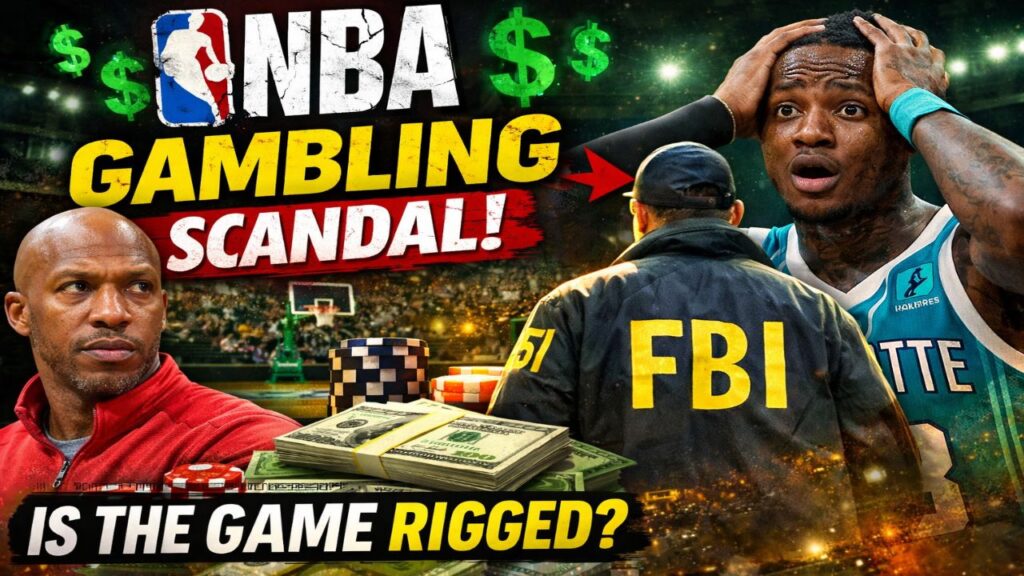
The NBA has always sold itself as the cleanest, smartest, most progressive league in American sports. From player empowerment to global branding, it’s built an image of control, transparency, and trust. But now, that image is cracking. Quietly at first, and then all at once, the whispers started spreading through front offices, sportsbooks, and locker rooms. Games that didn’t feel right. Betting lines that moved too perfectly. Player performances that suddenly made no sense. At first, fans brushed it off as coincidence. Then analysts started asking uncomfortable questions. And now, the league finds itself staring into a mirror it never wanted to face. Because the biggest threat to basketball is no longer injuries, superteams, or even declining ratings. It’s the possibility that some games were never truly real to begin with.
This story doesn’t begin with one player. It doesn’t begin with one bet. It begins with the modern NBA’s relationship with gambling. Over the last few years, the league went all in. Betting partnerships. Official sportsbook sponsors. Odds flashing on TV screens during live games. Commentators talking spreads and props as casually as they once talked about points and rebounds. What was once pushed into the shadows became part of the broadcast. The NBA didn’t just allow gambling to exist around it. It invited gambling inside. And when you invite money into a space built on competition, you don’t just change the business. You change the incentives.
Players, coaches, staff, and even people connected to them suddenly found themselves surrounded by millions of dollars riding on tiny details. Not just who wins or loses, but how many points a player scores, how many rebounds someone grabs, whether a star checks out early, or whether a bench guy suddenly plays more minutes. These aren’t small bets anymore. They’re massive markets. And when the money becomes big enough, temptation follows.
The first signs that something was wrong didn’t come from the NBA. They came from the betting world. Sharp bettors started noticing strange patterns. Certain player props would shift hard just minutes before tipoff. A backup guard’s over-under on points would suddenly spike, even though nothing publicly had changed. A star’s rebound line would drop for no obvious reason. Then the game would start, and somehow, the numbers would hit with eerie precision. A player would sit early. Another would play through foul trouble. A rotation would change without explanation. To fans, it looked like bad coaching or random variance. To people who follow betting markets, it looked like information was leaking.
And once that idea takes hold, everything changes. Because if someone knows something before the public does, that’s not luck. That’s an advantage. And in gambling, an advantage is everything.
Behind the scenes, investigators started connecting dots. Phone records. Betting accounts. Text messages. Relationships between players and people placing massive wagers. What they found wasn’t one isolated case. It was a network. A web of connections between people who had access to insider information and people who knew how to turn that information into money. And suddenly, the idea that the NBA could be compromised didn’t sound so crazy anymore.
What makes this story so explosive is not just that gambling happened. It’s who may have been involved. We’re not talking about some random end-of-bench player quietly placing a bet on his own team. We’re talking about people with real influence. People who could affect minutes, lineups, and game flow. People who knew when a player was nursing an injury that wouldn’t show up on the injury report. People who knew when a coach planned to rest a starter or experiment with rotations. That information, in the wrong hands, is worth millions.
Imagine knowing that a star isn’t going to push himself tonight, even though he’s officially listed as available. Imagine knowing that a role player is about to get extra run because of something going on behind closed doors. Imagine knowing that a coach has been told to limit someone’s minutes quietly. If you know that before the sportsbooks do, you can beat the system every time.
And that’s the nightmare scenario for the NBA. Because basketball is uniquely vulnerable to this kind of thing. One player can swing a game. One substitution can change a spread. One missed shot can flip a prop bet. Unlike football, where there are dozens of players on the field, or baseball, where outcomes are spread over hundreds of pitches, basketball is intimate. It’s controlled by a handful of people on the floor. And when money starts whispering in their ears, the damage can be devastating.
As the investigation deepened, the tension inside the league skyrocketed. Front offices started to panic. Agents started making calls. Players started watching their phones more carefully. Because no one knew who might be next. No one knew how far it went. And no one knew how much of the last few seasons might suddenly be questioned.
The scariest part for fans is this: if even a small number of games were influenced, it changes everything. That buzzer-beater you celebrated. That playoff run that broke your heart. That bet you lost by half a point. All of it becomes suspect. And once trust is gone, it’s almost impossible to get back.
The NBA has always positioned itself as the most player-friendly league. But with that freedom comes risk. Players are celebrities now. They have entourages, business partners, friends from their past, people who rely on them. And not all of those people have the same values. Some see a player not as a human being, but as a walking information goldmine. Someone who knows things before the world does. Someone whose casual comment in a text message can become a six-figure payday for the wrong person.
That’s where things get truly dangerous. Because the player might not even realize what they’re doing. A simple “yeah, my knee is acting up tonight” sent to the wrong person can turn into a flood of money being wagered against them. A casual “coach might rest me” can move markets. Suddenly, the player is part of something much bigger than they ever intended.
And once money starts flowing, it doesn’t stop. People want more. They push for more information. They start asking questions. They start applying pressure. And eventually, lines are crossed.
What’s made this situation so explosive is the growing belief that the league didn’t just miss the warning signs. It created them. By embracing gambling so publicly, by partnering with sportsbooks, by normalizing betting as part of fandom, the NBA opened the door. It made betting cool. It made betting constant. And it put players in the middle of a massive financial machine they were never trained to handle.
Now the league is scrambling. Officials are talking about stricter rules. Tighter injury reporting. More monitoring of betting patterns. Education programs for players. But critics say it’s too late. The damage has already been done. Because once people believe that games might be influenced by money, every missed free throw becomes suspicious. Every blowout becomes questionable. Every coaching decision gets a side-eye.
And the fans feel it. You can see it online. Comment sections filled with accusations. People saying the league is rigged. That refs are involved. That players are in on it. Whether those claims are true or not doesn’t even matter anymore. The perception alone is toxic. Because sports only work if people believe in them.
The players are in a brutal position too. Most of them just want to hoop. They want to compete. They want to win. But now, they’re being looked at not just as athletes, but as potential liabilities. Every injury update. Every late scratch. Every unusual performance becomes part of a bigger story. And for players who have done nothing wrong, that’s devastating. Because they’re being pulled into a storm they didn’t create.
Behind closed doors, teams are terrified. Not just of punishment, but of embarrassment. The NBA brand is worth billions. TV deals. Sponsorships. Global reach. All of it depends on the idea that the game is fair. If that idea collapses, the ripple effects could be enormous. Advertisers don’t want to be associated with a tainted product. Fans don’t want to invest their emotions in something that feels fake. And players don’t want their legacies questioned.
This isn’t just about one scandal. It’s about the future of the sport. Because if the NBA can’t prove that it has control over its own game, then everything it’s built over the last few decades is at risk. The league survived fights, lockouts, and even a pandemic. But this is different. This strikes at the core of what basketball is supposed to be.
The irony is that the NBA chased gambling money to grow the league. More engagement. More fans. More revenue. But in doing so, it may have invited the one thing that could tear it apart. Because when the outcome of a game is tied to massive financial markets, the purity of competition becomes fragile.
And now, as investigations continue and more details threaten to come out, everyone is waiting for the next bombshell. The next name. The next connection. The next revelation that pushes this from troubling to catastrophic.
Fans are asking questions they never thought they’d ask. Did my team really lose because they were outplayed, or because something else was going on? Was that star really hurt, or was there another reason he didn’t play? Was that fourth-quarter collapse just bad basketball, or something darker?
The truth is, most games are probably clean. Most players are probably honest. Most coaches are probably just trying to win. But in a world where even a tiny percentage of corruption can shift millions of dollars, “probably” isn’t good enough.
The NBA is standing on the edge of a cliff. One step leads to transparency, accountability, and a chance to rebuild trust. The other leads to endless doubt, lawsuits, and a fanbase that no longer believes what it’s watching.
This scandal isn’t just a headline. It’s a warning. A warning about what happens when money and competition collide without enough safeguards. A warning about how quickly trust can be lost. And a warning that even the biggest leagues in the world are not immune to the oldest problem in sports: greed.
The next few months will define the NBA for a generation. Will the league clean house and prove it’s still worthy of the fans’ faith? Or will more secrets spill out, dragging the game into a darkness it may never fully escape?
One thing is certain. The games we’re watching now are no longer just about basketball. They’re about belief. And once belief is gone, no amount of highlight reels can bring it back.
Also Read: Latest Trending News