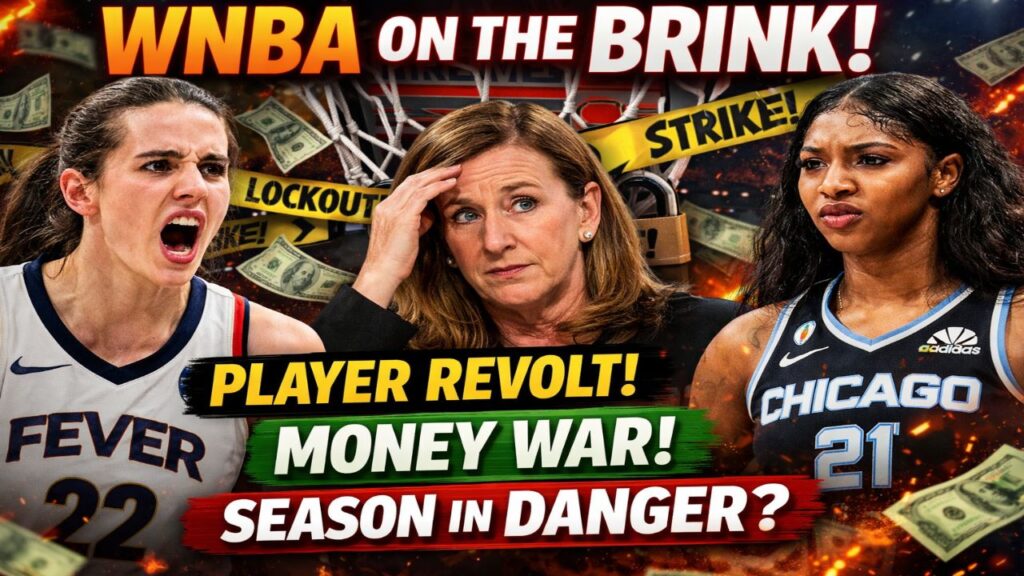
The WNBA is standing on the edge of something it has never faced before, and most fans still don’t realize how serious it is. Behind the highlight reels, viral rookie moments, packed arenas, and record-breaking TV numbers, a silent storm has been building for months. Now it has finally broken. The league and the players’ union have failed to agree on a new Collective Bargaining Agreement, and that failure has cracked open the door to something nobody wants to say out loud: a potential strike, a lockout, and the possibility that the fastest-growing women’s sports league on Earth could suddenly grind to a halt. This is not just about contracts. This is not just about money. This is about power, respect, and who really owns the future of women’s basketball.
For the first time in modern WNBA history, the old agreement expired without a replacement ready. That single moment changed everything. Overnight, every contract, every free-agency move, every offseason plan entered a strange gray zone. Teams don’t know if they can sign players. Players don’t know if they will be paid under new terms or old ones. Fans don’t know if the season they’re excited about will even happen on time. And the tension behind closed doors is now spilling out into the public, because both sides believe they are being treated unfairly. The league says it is being pushed beyond its financial limits. The players say they are being exploited during the most profitable era in WNBA history.
To understand why this is so explosive, you have to understand what has happened to the WNBA over the last two years. Attendance has skyrocketed. Television ratings have exploded. Merchandise sales are higher than they have ever been. Rookie stars are selling out arenas in cities that used to struggle to fill half their seats. Social media engagement is through the roof. The league has never been more visible, more relevant, or more powerful. And the players know it. They are not guessing. They see the numbers. They see the sponsorship deals. They see the broadcast contracts. They see the headlines calling this the golden era of women’s basketball. So when they look at their paychecks and their working conditions, something doesn’t add up.
Many players are still making salaries that, in any other major professional sport, would be considered shockingly low. Some still need offseason jobs overseas just to stay financially stable. Some are playing in brutal travel schedules, flying commercial while the league makes millions off their performances. So when the union came to the negotiating table, they didn’t come politely. They came with demands that matched the moment. They wanted a bigger share of revenue. They wanted higher salaries. They wanted better benefits, better travel, better healthcare, and more control over their careers. In their minds, they were not asking for luxury. They were asking for fairness.
The league, however, saw it differently. Executives argued that while the WNBA is growing fast, it is still not as financially secure as the public thinks. They warned that giving players everything they asked for could push the league into losses that could threaten its long-term survival. Behind the scenes, owners began pushing back. Some franchises operate on thin margins. Some rely on shared revenue. Some are still trying to recover from years of losses before this boom even started. From their perspective, the union’s demands were not just aggressive. They were dangerous.
That is where the talks started to fall apart. The players felt disrespected. The league felt pressured. Every proposal turned into a battle over who was telling the truth about the league’s finances. Every counteroffer felt like an insult to the other side. And when the deadline hit without a deal, everything went nuclear. Social media erupted. Fans picked sides. Players started posting cryptic messages. Rumors of strikes and lockouts started spreading like wildfire. Suddenly, what had been a quiet negotiation became a public war.
One of the most dangerous parts of this situation is timing. This is not happening in a slow year for the WNBA. This is happening during a historic boom. Stars are becoming household names. The league is attracting new fans every week. Sponsors are paying attention. Networks are investing more money. Expansion teams are being planned. This should be a moment of celebration. Instead, it has become a moment of chaos. If games are canceled, if the season is delayed, if fans turn away in frustration, the damage could be massive. Momentum is fragile. You don’t get it back easily once it’s lost.
And then there are the players caught in the middle. Young stars entering the league right now are in a terrifying position. Their rookie years are supposed to be the foundation of their careers. Their marketability, their contracts, their future endorsements all depend on visibility and stability. If the league shuts down or even stumbles, those opportunities shrink. Veterans are also at risk. Some are in the final years of their careers. They don’t have time to wait out a long labor war. Every missed season is a piece of their legacy gone forever.
What makes this even more dramatic is the contrast between the public image of the WNBA and the reality of these negotiations. On TV, everything looks perfect. Sold-out crowds. Intense rivalries. Highlight plays going viral. But behind that curtain, trust is breaking down. Players are starting to believe that the league does not value them the way it claims. The league is starting to believe that the union does not care about the survival of the business. Once that kind of mistrust sets in, compromise becomes incredibly difficult.
Some fans are already choosing sides. Many say the players deserve everything they are asking for. They point to the sacrifices women athletes have made for decades. They point to how underpaid women’s sports have been compared to men’s leagues. They argue that now that the WNBA is finally making money, the athletes who built it should reap the rewards. Others worry that pushing too hard could kill the very thing everyone fought so long to build. They remember leagues that collapsed after labor wars. They fear that sponsors and broadcasters might walk away if the chaos continues.
There is also a deeper, more emotional layer to this. Women’s basketball has spent years fighting for respect. Every breakthrough has been hard-won. Every milestone has come after endless struggle. To see the league on the verge of tearing itself apart just as it reaches new heights feels tragic to many fans. It feels like watching a rocket reach the edge of space, only to run out of fuel right before breaking through.
The silence from the league office has only made things worse. Without clear communication, rumors fill the void. Players hear one thing. Teams hear another. Fans are left guessing. And in that uncertainty, anger grows. Some players feel the league is intentionally stalling, hoping the union will back down. Some owners feel the union is trying to force their hand by threatening chaos. Neither side wants to be seen as the villain, but both sides are preparing for a fight.
If this turns into a strike, it would mean players refusing to play until a deal is reached. If it turns into a lockout, it would mean the league shutting players out until they accept new terms. Either way, the result is the same for fans: no games, no highlights, no season as promised. And every day without basketball is a day where the momentum of the WNBA slips just a little bit more.
There is also a massive global impact. The WNBA is not just an American league anymore. It has fans all over the world. Young girls look up to these players as role models. International stars come to the league to compete at the highest level. A shutdown would not just hurt the business. It would hurt the image of women’s sports worldwide.
Yet, despite all this danger, both sides believe they are right. The players believe this is their moment, and if they don’t fight now, they never will. The league believes it must protect its future, even if that means standing firm. That is what makes this so volatile. When both sides feel morally justified, compromise becomes almost impossible.
Some insiders believe a deal will eventually get done at the last minute. That has happened before in sports. Deadlines create pressure. Pressure creates movement. But even if an agreement is reached, the damage may already be done. Trust, once broken, is hard to rebuild. Players will remember how this made them feel. Owners will remember how close everything came to collapse. That tension could shape the league for years.
This is why this story is so much bigger than contracts and numbers. It is about the soul of the WNBA. Is it a league that truly values its athletes as partners in its success? Or is it a business that will always put financial caution above player empowerment? The answer to that question will define the next decade of women’s basketball.
Right now, fans are holding their breath. They want to believe that the league they love will survive this storm. They want to believe that the players who inspire them will get what they deserve. But they also know that history is full of leagues that never recovered from labor wars. The clock is ticking. Every day without a deal raises the stakes. And somewhere behind closed doors, two sides are staring each other down, both convinced they are fighting for the future.
The WNBA has never been more powerful, more visible, or more important than it is right now. That is what makes this moment so terrifying. The league is standing on the edge of greatness and the edge of disaster at the same time. What happens next will not just decide a season. It will decide the legacy of women’s basketball in this generation.
And until that agreement is signed, until that fight is settled, one truth remains: the WNBA is not just playing basketball right now. It is playing the most dangerous game of all — a battle for its own survival.
Also Read: Latest Trending News