The NBA sells itself as the most skilled, most competitive basketball league on the planet. Superstars, rivalries, legacies, history being written every single night. But every once in a while, something happens that makes fans stop arguing about players… and start questioning the league itself. And that’s exactly what happened in the controversial ending between the Philadelphia 76ers and the Houston Rockets — a moment that didn’t just decide a game, but reignited one of the biggest, ugliest debates in modern NBA history: Can fans still trust NBA officiating?
Because this wasn’t just a missed call. This wasn’t a bang-bang play that people would forget in a day or two. This was the kind of moment that explodes across social media, divides fanbases, and makes even neutral viewers say, “Wait… how did the refs miss THAT?” And when the NBA finally responded, instead of calming the storm, it poured gasoline on the fire.
Let’s break down what actually happened, why fans are furious, why players are fed up, and why this controversy could be a warning sign for something much bigger than one regular-season game.
The final minutes of the 76ers versus Rockets game were already intense. Close score. High pressure. Every possession mattered. Players were locked in. Coaches were pacing. Fans were on edge. This is the kind of moment the NBA lives for — where stars are supposed to decide the outcome, not whistles. And then it happened.
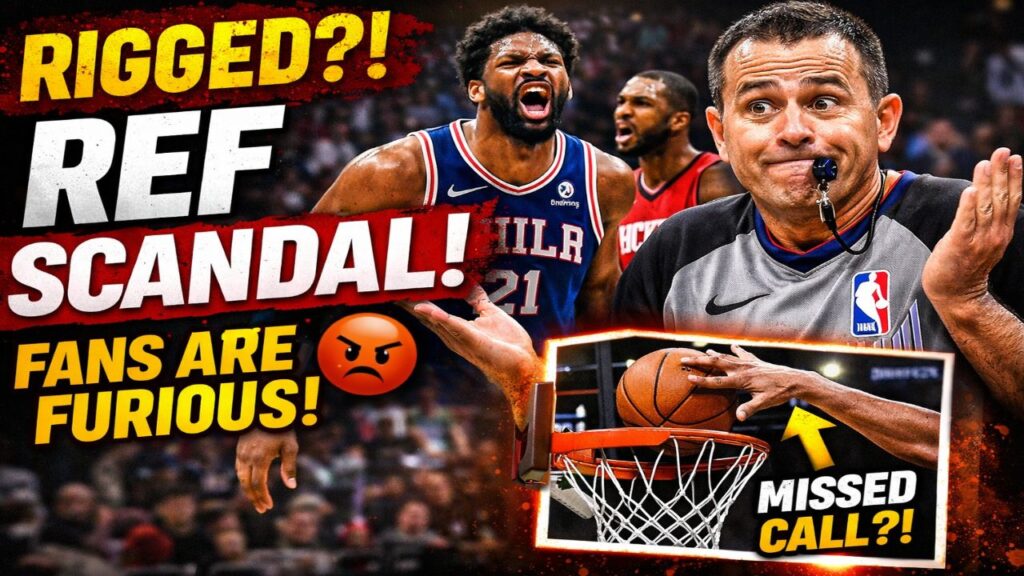
A shot went up near the rim. The ball was on its way down. A defender made contact with it. On replay, it looked painfully obvious to a massive portion of the basketball world that this should have been goaltending. Not borderline. Not debatable. Just… clear. But the whistle never came. Play continued. The moment passed. The game ended. And just like that, everything exploded.
Within minutes, social media was flooded with slowed-down clips, zoomed-in angles, freeze frames, and fans asking the same question over and over again: How is that not goaltending? Analysts began replaying the clip on television. Former players weighed in. Coaches gave carefully worded answers that said everything without saying too much. And fans from both sides — not just the losing team — started calling it one of the worst non-calls of the season.
This is where things shifted from frustration to outrage. Because when a call is missed in real time, fans can sometimes understand. NBA speed is insane. Players move fast. Officials don’t have replay access mid-play. Mistakes happen. But the anger wasn’t just about the miss — it was about the pattern.
NBA fans have been complaining about officiating for years. Inconsistent calls. Superstar treatment. Soft technicals. Late-game whistles deciding outcomes. And every time, the league says the same thing: officials are held accountable, mistakes are reviewed, improvements will be made. But then moments like this happen — moments that feel so obvious that fans start believing something deeper is wrong.
When the NBA finally addressed the play, many expected clarity. Accountability. Maybe even an admission that the call was wrong. What they got instead felt like corporate damage control. A carefully worded response. A technical explanation. No real consequences. No real closure.
And that response might have made things worse.
Because fans didn’t hear transparency. They heard excuses. They didn’t hear accountability. They heard deflection. And when trust is already fragile, that’s the worst possible outcome.
Players notice this too. They don’t say it outright — at least not often — but you can hear it in their tone during postgame interviews. You can see it in the way they react to whistles. The hands thrown up. The sarcastic claps. The long stares at officials after a call. Players know when games are being decided by things they can’t control.
And when stars feel that way, it affects the product on the court.
Think about it. Basketball is rhythm. Confidence. Flow. When players are worried about inconsistent officiating, they hesitate. They avoid contact. They stop attacking the rim. They play not to get called for a foul instead of playing to win. And that’s when the game suffers.
This is why fans are so angry about this particular moment. Not because it involved the 76ers or the Rockets specifically — but because it represents something bigger. It represents the fear that no matter how good your team is, no matter how clutch your players are, the final outcome might still depend on a missed call that never gets fixed.
And let’s talk about the timing. This isn’t early November basketball that nobody remembers. This is the part of the season where playoff positioning matters. Where one win or loss can decide seeding, home-court advantage, or even whether you make the playoffs at all. One missed call can ripple across an entire conference.
Fans immediately started asking uncomfortable questions. If this happens in a nationally discussed regular-season game, what happens in the playoffs? What happens in a Game 7? What happens when a championship is on the line?
We’ve seen this movie before.
From infamous playoff no-calls to controversial Finals moments, the NBA has a long history of officiating decisions that are still argued about decades later. And every new controversy doesn’t replace the old ones — it stacks on top of them.
That’s why the phrase “rigged” always creeps into the conversation, even if most fans don’t truly believe the league is fixed. It’s not about conspiracies — it’s about credibility. When mistakes feel random and unaddressed, people stop trusting the system.
And trust is everything.
The NBA is not just competing with other sports anymore. It’s competing with streaming, gaming, social media, and short attention spans. Fans have infinite entertainment options. If they start believing outcomes are unreliable, they won’t just complain — they’ll disengage.
What makes this even more dangerous for the league is how fast these moments spread now. One clip. One angle. One tweet. And suddenly millions of fans have seen the play from better views than the referees had in real time. Technology has outpaced officiating.
Fans can slow it down. Zoom in. Analyze frame by frame. And when the replay looks clear to the public but isn’t acknowledged by the league, it creates a credibility gap that keeps growing.
Some fans argue that replay should be expanded. Others want challenges to be unlimited in the final minutes. Some want an off-site officiating command center making real-time decisions. Others believe refs should face public accountability the same way players do.
And then there are fans who are just tired. Tired of explanations. Tired of apologies. Tired of being told to “move on.”
Because from their perspective, it keeps happening.
This controversy also reignites the debate around star treatment. Would this call have been missed if a different player was involved? Would it have gone differently in a nationally hyped matchup? Fans hate asking these questions — but they keep asking because moments like this make them feel unavoidable.
The league insists that officiating is neutral. That refs don’t favor teams or players. And while that may be true in intent, perception matters almost as much as reality. And right now, perception is not on the NBA’s side.
What’s scary is that even fans of teams who benefited from the non-call were uncomfortable. When your own win feels tainted, it takes the joy out of it. Nobody wants to win like that. Players don’t want it. Coaches don’t want it. Fans definitely don’t want it.
Basketball should be decided by skill, execution, and heart — not by confusion and controversy.
This is why this moment won’t be forgotten quickly. It’s not just a missed goaltending call. It’s a symbol. A snapshot of a growing frustration that’s been building for years.
And unless the league makes real changes — not just statements — moments like this will keep happening. And every time they do, they chip away at something the NBA can’t afford to lose: belief.
Belief that the game is fair. Belief that results matter. Belief that when the clock hits zero, what fans just watched was decided by the players on the floor.
Because once that belief is gone, no amount of star power can bring it back.
And the most dangerous part? This controversy didn’t even involve the biggest names in the league. Imagine what happens when something like this decides a Finals game. Or eliminates a superstar’s team from the playoffs. Or ends a dynasty.
If the NBA doesn’t treat moments like this as wake-up calls instead of PR problems, the outrage won’t slow down — it will snowball.
And the next time it happens, fans won’t just be angry.
They’ll be done.
Also Read: Latest Trending News