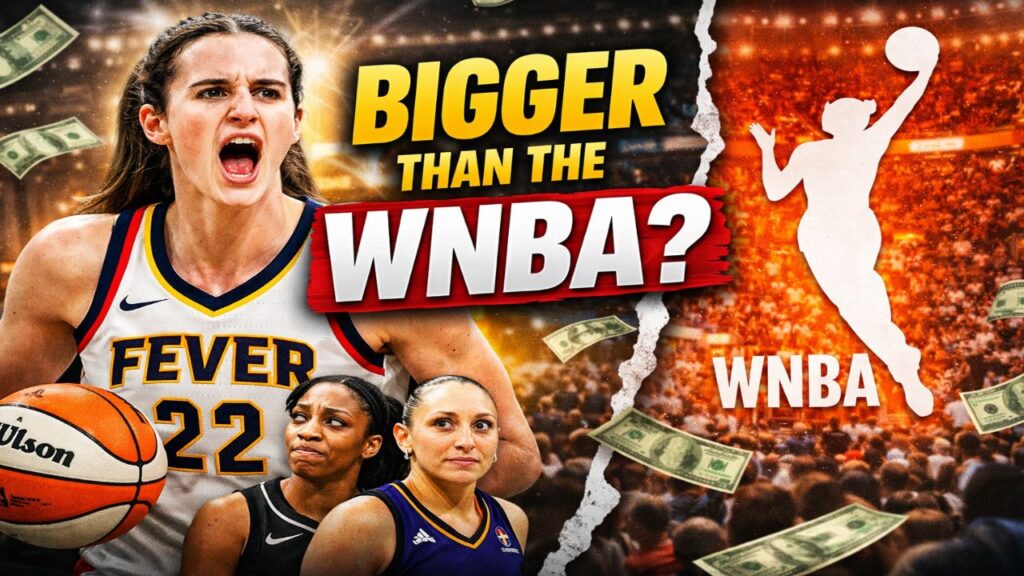
The WNBA has spent decades trying to grow into a stable, respected, and widely watched professional league. From its founding in 1997 to today’s expansion era, the league has seen stars come and go — legends like Lisa Leslie, Diana Taurasi, Sue Bird, and Maya Moore carried the game forward through years when national attention came in waves rather than consistently. But in the middle of all that history, a new conversation has taken over the basketball world, and it’s louder than anything the league has experienced before. That conversation revolves around one simple but uncomfortable question: what happens when a single player becomes bigger than the league itself? Because right now, many fans believe that’s exactly what’s happening with Caitlin Clark.
Before Clark ever stepped onto a WNBA court, she was already changing the economics of women’s basketball. At Iowa, she wasn’t just a great college player — she became a cultural moment. Her deep three-pointers, logo shots, confident celebrations, and record-breaking scoring turned ordinary college games into national events. Television ratings for women’s college basketball exploded. Arenas sold out across the country, even when Iowa was the visiting team. Jerseys sold at levels rarely seen in women’s sports. Social media clips of her performances spread far beyond traditional basketball audiences. People who had never watched women’s basketball before suddenly had a reason to tune in.
When Clark entered the WNBA, many believed the league was about to experience its biggest growth surge ever. And in some ways, that prediction came true immediately. Ticket sales increased dramatically wherever her team played. Television ratings jumped. Merchandise demand surged. The league suddenly found itself in conversations on sports talk shows that had rarely discussed the WNBA before. Even casual fans could name a current WNBA player — something that historically wasn’t common outside dedicated basketball circles.
But with that attention came tension. Because growth driven by one player creates a complicated reality. The WNBA has always promoted itself as a league built on collective excellence, competitive balance, and respect for veterans who spent years building the foundation of the sport. Suddenly, the spotlight shifted heavily toward a rookie. And not just any rookie — one whose popularity seemed to rival, or even exceed, the visibility of the league itself.
Some fans celebrated this moment as long overdue. They argued that every sports league needs a transcendent star to break into mainstream culture. The NBA had Michael Jordan, then Kobe Bryant, then LeBron James. Tennis had Serena Williams. Golf had Tiger Woods. These athletes didn’t just play their sport — they expanded its audience. From that perspective, Caitlin Clark wasn’t overshadowing the WNBA. She was accelerating its growth.
Other fans, however, saw something different. They worried that the conversation around Clark was becoming so dominant that it risked minimizing the achievements of established stars. After all, players like A’ja Wilson, Breanna Stewart, and Diana Taurasi built championship legacies long before Clark arrived. These players carried the league through seasons when media attention was limited. For them, the sudden shift in coverage felt uneven.
This tension became most visible in media debates. Sports shows began focusing heavily on Clark’s performances, her struggles, her fouls drawn, her minutes played, and even her treatment by opposing teams. Meanwhile, dominant performances by MVP candidates sometimes received less attention. Fans noticed the imbalance and started arguing online. Some claimed the league needed to embrace Clark as its biggest marketing opportunity ever. Others insisted the league should protect its identity as more than a single-player story.
Then came the physical-play debate. As Clark adjusted to professional basketball, defenders played her aggressively — something common for high-profile rookies in any league. Hard screens, tight defense, and physical contact became recurring highlights on social media. Supporters argued she was being targeted because of her fame. Critics responded that this was simply how professional basketball works, especially for rookies entering a competitive league.
The discussion quickly expanded beyond basketball strategy. It became about respect, tradition, and change. Some veterans spoke carefully about the adjustment period rookies face. Others emphasized that the league had always been physical. Fans interpreted every comment differently, often through the lens of whether they supported Clark’s rise or felt protective of the league’s existing stars.
At the same time, the numbers told a powerful story. Attendance in arenas increased when Clark’s team visited. Secondary ticket markets showed higher prices for those games. Television broadcasts featuring her drew significantly larger audiences than typical regular-season matchups. Social media engagement spiked whenever she played. Even highlight clips from routine plays attracted millions of views.
For league executives, this created both opportunity and pressure. On one hand, the visibility was invaluable. Sponsors became more interested. Networks saw proof that women’s basketball could draw large audiences. Expansion discussions gained momentum. On the other hand, building a sustainable future requires more than one superstar. The league had to figure out how to convert Clark’s popularity into long-term growth for all teams and players.
This is where the “bigger than the league” conversation becomes complicated. No professional league wants to depend entirely on one athlete, but every league benefits from having one. Michael Jordan didn’t replace the NBA — he elevated it. The question is whether the WNBA can turn Clark’s popularity into a rising tide that lifts every franchise, rather than a spotlight focused too narrowly.
Another layer of the debate involves generational change. Younger fans who discovered women’s basketball through Clark often follow the sport differently than long-time WNBA supporters. They engage heavily on social media, watch highlights instead of full games, and follow individual players more than teams. That shift in fan behavior can feel disruptive to traditional sports culture, but it also represents growth.
Meanwhile, Clark herself remains at the center of the storm without directly fueling it. Her interviews often emphasize respect for veterans, excitement about learning, and appreciation for the opportunity to play professionally. She rarely engages in controversy publicly, yet controversy follows her because of the attention she attracts. That dynamic is common for athletes who become cultural icons early in their careers.
As the season progresses, the basketball story continues evolving. Clark improves as she adjusts to defensive speed, physicality, and professional schedules. Opponents develop strategies specifically designed to limit her impact. Teammates adapt to playing alongside a high-usage rookie guard. Wins and losses begin to matter more than headlines.
But the larger conversation doesn’t disappear. Every record broken, every sold-out arena, and every viral highlight feeds the debate again. Is this the moment that finally pushes the WNBA into mainstream sports culture permanently? Or is it a temporary surge built around one extraordinary player?
The answer may depend on what happens next. If more young stars emerge and capture public attention, the league’s popularity could stabilize at a higher level. If teams continue seeing attendance increases beyond Clark’s games, it would signal lasting growth. If television deals expand and player salaries rise, the economic impact would become undeniable.
History suggests that leagues grow through moments like this. The NBA’s popularity didn’t rely solely on Jordan, but his presence accelerated everything. Magic Johnson and Larry Bird revived the league in the 1980s through rivalry. LeBron James carried global attention into the digital era. Each time, the league became bigger than before because it embraced the moment instead of resisting it.
For the WNBA, the Caitlin Clark era may represent a similar turning point. Not because she replaces the league’s identity, but because she forces it into the largest spotlight it has ever experienced. Growth often comes with discomfort, especially when long-standing structures suddenly change.
Fans arguing online about players, media coverage, and league priorities are actually signs of something important: people are paying attention. Debate means engagement. Engagement means interest. And interest is what professional sports leagues depend on.
The real story might not be whether Caitlin Clark is bigger than the WNBA. The real story might be whether the WNBA is finally becoming big enough that one player can bring millions of new fans into the sport. Because if those fans stay, watch other teams, learn other players’ stories, and continue following the league after the novelty fades, then this moment won’t be remembered as controversy. It will be remembered as transformation.
For now, the conversation continues every night she steps on the court. Every deep three-pointer, every packed arena, every heated online debate adds another chapter to the story. And whether people love the attention or resist it, one thing is clear: women’s basketball is being watched more closely than ever before.
And sometimes, in sports, that kind of attention changes everything.
Also Read: Latest Trending News