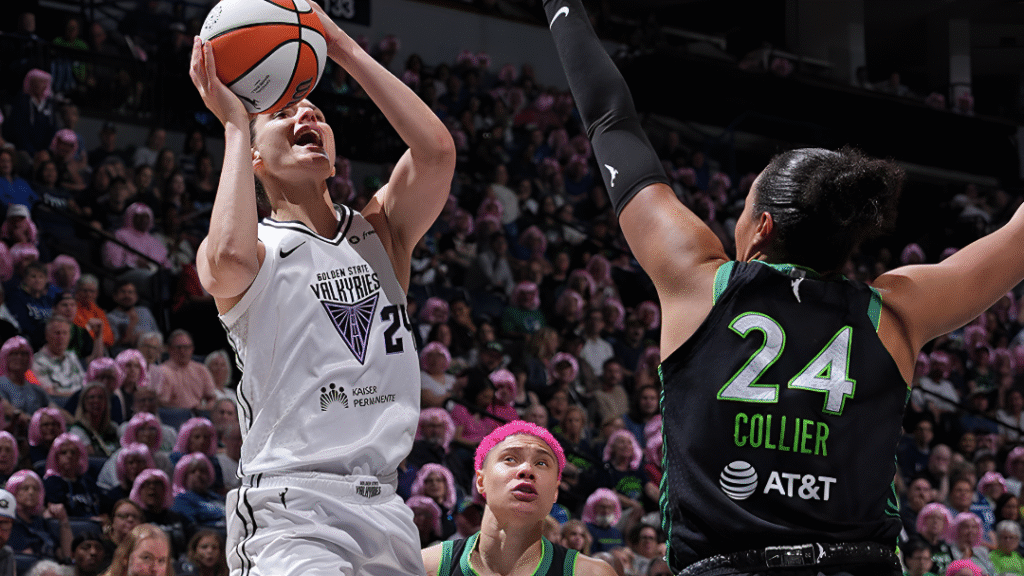
Golden State Valkyries attendance record sparks a new WNBA era, with sold-out arenas, rookie nerves, and Bay Area fans rewriting women’s basketball history.
The Golden State Valkyries didn’t ease their way into the WNBA—they burst through the doors. In their first season, they sold out every single home game at the Chase Center and broke league attendance records. The wins will take time, but one truth is undeniable: the Valkyries have changed what people thought was possible for women’s basketball.
Opening night in San Francisco felt less like a debut and more like a festival. The sun set over the Bay, and fans streamed into the arena hours early, kids waving handmade posters and parents juggling popcorn and jerseys. Inside, 18,000 voices rattled the walls before tipoff.
On the court, players admitted their nerves. One rookie laughed about how her hands shook during warmups. “I kept telling myself—‘You’ve played this game forever. Just breathe. Just hoop.’ But then I looked up and thought, wow, all these people really came to see us. That hit different.”
That was the story: this wasn’t just another game. It was the birth of something new.
The Valkyries didn’t just show up—they landed in the perfect city at the perfect time. San Francisco has always been a place that embraces change, movements, and energy. Tech, culture, protests, music—it all finds a home here. Now it’s women’s basketball’s turn.
The tunnel walk became an instant hit on social media. Rookies experimenting with bold streetwear, veterans mixing designer fits with sneakers—it all ended up online within minutes. TikTok edits of Valkyries players walking into the arena were racking up hundreds of thousands of views. Sponsors noticed. Bay Area companies rushed to attach their name to the team, eager to ride the wave.
But the real cultural shift was in the stands. Families came together in Valkyries gear. Young girls finally had a hometown team to look up to. One mom, with her daughter in tow, said it best: “I brought her here so she can see it for herself—women filling an arena, playing at the highest level, and everyone cheering them on.”
That’s not just basketball—that’s legacy.
It wasn’t always like this. Ask anyone who’s followed the WNBA since the beginning, and they’ll tell you how expansion teams once struggled just to be noticed. Back in the 2000s, new teams would play to half-empty arenas, sometimes fighting just to get local media coverage.
Now? The Valkyries flipped the script from day one. More than 18,000 fans a night. Ticket resale prices as high as NBA games. Jerseys selling out in hours. They didn’t crawl into the league—they came in loud, bold, and undeniable.
In some ways, it’s a reflection of how far the WNBA has come. Legends like Sheryl Swoopes and Lisa Leslie laid the foundation. Candace Parker carried the torch. Now the Valkyries are proving that women’s basketball doesn’t just deserve attention—it demands it.
“We expected excitement, but this? Selling out every home game in our first season? That’s history,” said a Valkyries executive.
“For me, walking into the arena and hearing that roar before I’d even touched the ball—it gave me chills,” a rookie guard shared. “I’ll never forget that feeling.”
A veteran forward summed it up: “Expansion years are usually quiet. You lose, you grow, and nobody really notices. But here? Every game feels like the playoffs already. The energy is that crazy.”
For the Valkyries, the benefits are obvious. Packed houses mean financial security. A booming fan base makes free agents think twice about signing elsewhere. Sponsorship money keeps pouring in. The challenge? Expectations. Usually, expansion teams get a few years of patience. The Valkyries? Fans are already demanding wins.
For the league, this is a goldmine. The Valkyries prove expansion isn’t a gamble anymore—it’s a blueprint. Put a team in the right city, market it the right way, and fans will show up. That’s huge for the WNBA as it eyes new markets like Philadelphia, Portland, and Toronto. The Valkyries have given the league proof that the hunger for women’s basketball is bigger than skeptics thought.
The fans have been the heartbeat of this story. Social media tells it better than stats ever could. Clips of the Chase Center packed wall-to-wall, kids screaming for autographs, and fans chanting long after the final buzzer.
One viral tweet showed a young girl holding up a sign: “First WNBA game, won’t be my last.” Another said: “The Bay didn’t just get a team—we got a movement.”
Even fans from outside California are flying in just to catch a Valkyries game. Some post videos of themselves making the trip, calling it “a pilgrimage” to witness history. In an age when attention spans are short, the Valkyries have managed to become must-see basketball in a matter of months.
But here’s the catch: hype doesn’t win games. The Valkyries will eventually be judged by their record, not just the noise in the stands. Can the rookies handle the grind of an 82-day season? Can the veterans keep everyone steady through inevitable losing streaks?
And then there’s the bigger picture—can this level of support last? Selling out in year one is incredible. Doing it in year five, after the shine of “new” wears off—that’s the real test. If they pull it off, the Valkyries won’t just be a successful franchise—they’ll be a model for how the WNBA grows into a true national powerhouse.
The Golden State Valkyries’ debut season has already made history. They’ve proven that if you give women’s basketball the platform, people will show up—and not just show up, but show out in record numbers.
This team is more than a box score. They’re a movement, a reflection of where women’s sports are headed. Whether the Valkyries become contenders next year or need time to find their footing, one thing is certain: they’ve already left their mark.
Because this isn’t just about San Francisco. This is about the future of the WNBA. And thanks to the Valkyries, that future has never looked brighter.
Also Read: Latest Trending News