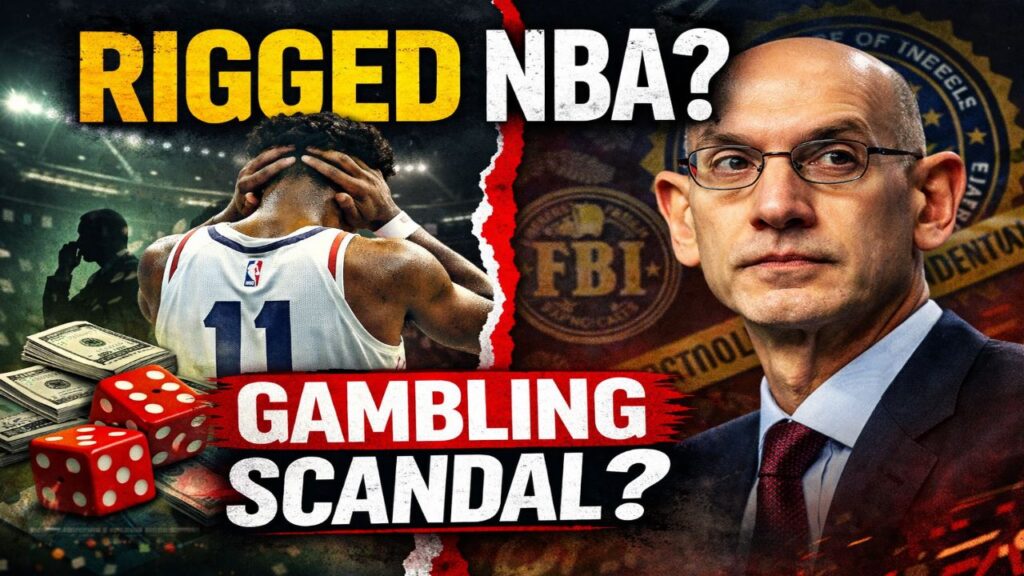
The NBA has always sold us a story. A story about purity of competition, about stars earning greatness through talent, work ethic, and pressure moments. We believe the outcomes are organic. We believe the scoreboard is sacred. But what if that belief is the biggest illusion in modern sports? What if the league we love is standing on the edge of a scandal that could change how fans see basketball forever?
Because right now, behind the highlights, the endorsements, and the viral clips, there is a storm building. And it’s not coming from a bad call, a trade demand, or locker-room drama. It’s coming from money. Gambling money. Quiet money. Dangerous money. And once you connect the dots, it becomes impossible to ignore.
For years, the NBA stayed far away from sports betting. Publicly, it was treated like a disease. A threat to integrity. Something that could corrupt the game. Then suddenly, everything changed. Betting ads flooded broadcasts. Betting sponsors appeared on jerseys. Betting odds became part of the live viewing experience. Analysts casually discussed point spreads during games. The league didn’t just accept gambling — it embraced it.
And fans didn’t question it. Why would they? It was normalized. Made shiny. Made safe. Or at least, that’s what we were told.
But normalization creates opportunity. And opportunity creates temptation.
Here’s the part nobody wants to say out loud: you don’t need to rig an entire game to make millions. You don’t need a superstar missing shots on purpose. You don’t need a referee blatantly fixing outcomes. All you need is one moment. One substitution. One strange foul. One player staying in a little longer than expected. One missed rotation. One injury report that doesn’t quite match what happens on the floor.
Micro moments decide betting outcomes. And micro moments are easy to hide.
This is where the story gets uncomfortable.
Because federal investigators are no longer just looking at shady bettors or underground bookies. They’re looking at patterns. Unusual betting spikes. Correlated outcomes. Games where the money moved before the action happened. Situations where insiders appeared to know something the public didn’t.
And once investigators start following money, they don’t stop at the bottom.
They move upward.
Think about it from a human perspective. NBA players are not robots. Many come from difficult backgrounds. Many support entire families. Many are surrounded by people who see them as walking opportunities. Add fame, access, pressure, and gambling culture, and suddenly lines blur. Especially for players on the margins — rotation guys, two-way contracts, veterans fighting to stay in the league.
These are the players no one watches closely. These are the players who can affect outcomes without being blamed. Miss a rotation. Commit a silly foul. Lose a rebound battle. It looks like basketball. It feels natural. But the betting market notices.
And that’s where the danger lives.
The league wants you to believe integrity is protected by rules and oversight. But history tells a different story. Sports scandals don’t begin with villains twirling mustaches. They begin with silence. With denial. With organizations convincing themselves the problem isn’t big enough yet.
Remember, every major sports scandal was once dismissed as impossible.
Fans said refs would never do that. They said players would never risk their careers. They said leagues would never allow it. Until they did. Until the evidence became overwhelming. Until the truth forced itself into the open.
What makes this moment different is scale.
The NBA is now deeply intertwined with gambling money. Sponsorships. Partnerships. Broadcast integrations. That creates a conflict no league has ever navigated cleanly. Because how aggressively do you investigate a system that funds your growth? How transparent can you be without damaging the product?
This is why fans are uneasy. Not because they have proof — but because they feel something is off.
They see lines swing wildly before tip-off. They see role players having career nights at suspicious moments. They see stars resting without warning. They see injury reports that change hours before games. And slowly, subconsciously, trust erodes.
Once trust cracks, everything feels different.
A missed free throw isn’t just a miss anymore. A blown call isn’t just incompetence. A strange substitution isn’t just coaching. It becomes a question.
And the worst thing for any sport isn’t controversy. It’s doubt.
Because controversy still means people care. Doubt means people stop believing.
The NBA has built its empire on star power. On moments. On narratives. On fans emotionally investing in outcomes. But emotional investment only works when fans believe the game is real. The second fans believe outcomes are manipulated — even slightly — the magic dies.
This is why the league is nervous.
They’ll never admit it publicly. They’ll issue calm statements. They’ll talk about safeguards and monitoring systems. They’ll distance themselves from any wrongdoing. But behind closed doors, this is the nightmare scenario.
Not a single scandal — but a slow leak.
A drip of stories. A pattern of investigations. A few names here. A few suspensions there. Nothing explosive enough to force a reckoning. Just enough to keep suspicion alive.
And suspicion is poison.
Now add social media into the mix.
Every questionable play becomes a clip. Every odd stat line becomes a thread. Every betting slip becomes evidence. Fans act like detectives. Algorithms amplify outrage. Influencers frame narratives. Suddenly the league no longer controls the conversation.
That’s dangerous.
Because once fans decide the system is compromised, the truth almost doesn’t matter anymore. Perception becomes reality.
And here’s the most uncomfortable question of all.
What if the league already waited too long?
What if gambling influence didn’t start yesterday, or last season, or last year? What if it’s been quietly shaping outcomes for longer than anyone wants to admit? Not through grand conspiracies — but through incentives. Through access. Through information asymmetry.
That’s how corruption actually works. Not loudly. Quietly.
And if you’re wondering why this matters to you as a fan, the answer is simple.
Because if games aren’t pure, fandom becomes performance. Cheering becomes habit. Rivalries become theater. And the emotional payoff — the reason sports matter — disappears.
Nobody wants to invest their heart into something they believe is staged.
This is the crossroads moment.
The NBA can either confront this reality head-on, with transparency that risks short-term damage but preserves long-term trust… or it can manage optics, protect partnerships, and hope the story never explodes.
History tells us which option organizations usually choose.
But history also tells us how that ends.
So the real question isn’t whether gambling influence exists. It’s how deep it goes. Who knows about it. Who benefits from it. And how long fans will tolerate uncertainty before walking away.
Because once belief is gone, it never fully comes back.
And if you think this conversation is uncomfortable now, imagine what happens when a playoff series, a Finals game, or a championship moment becomes the center of suspicion.
That’s not just a scandal.
That’s an existential threat.
The NBA is bigger than ever. Richer than ever. Louder than ever.
But sometimes, the loudest empires fall from the quietest cracks.
And right now, that crack is widening.
Also Read: Latest Trending News