Something happened in the NBA that nobody was prepared for.
Not the fans. Not the analysts. Not even the league itself.
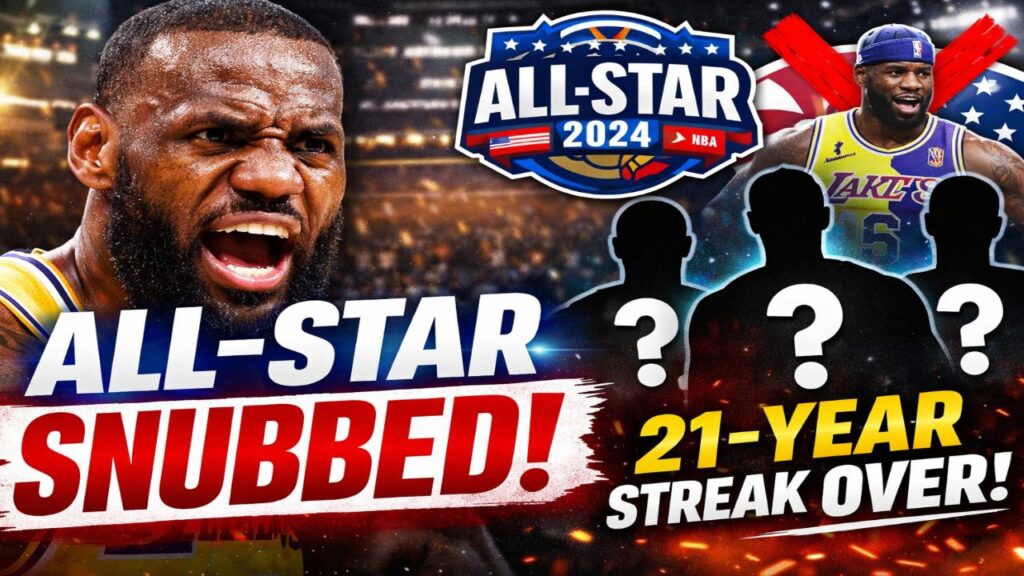
For the first time in more than two decades, LeBron James was not announced as an NBA All-Star starter.
Let that sink in.
Twenty-plus years of dominance.
Twenty-plus years of fan votes, media respect, and player recognition.
Twenty-plus years where LeBron James was automatic.
And then, suddenly… silence.
No graphic.
No name.
No “starter.”
And instantly, the basketball world exploded.
Some people called it disrespect.
Some people called it justice.
Some people said it was overdue.
Others said it crossed a line the NBA should never cross.
Because this wasn’t just about an All-Star game.
This felt like a message.
A message about age.
A message about power.
A message about legacy.
And maybe… a message about who the NBA wants to move on from.
So tonight, we’re breaking it all down.
What really happened.
Why it happened now.
And whether this was fair basketball logic — or a quiet changing of the guard.
Because once you strip away the stats and the voting numbers, one uncomfortable question remains:
Did the NBA finally decide it’s time to let LeBron go?
Let’s rewind.
For over 20 years, LeBron James has been the most unavoidable presence in basketball. From the moment he entered the league, the NBA didn’t just promote him — they built around him. Finals, MVPs, prime-time games, Christmas slots, global marketing — LeBron wasn’t part of the NBA machine. He was the engine.
Every season, even in down years, even when his teams struggled, LeBron’s All-Star starter spot was untouchable. Fans voted. Media voted. Players voted. And the result was always the same.
LeBron starts.
Until now.
This year, when the All-Star starters were announced, something felt off immediately. Fans were waiting for the familiar reveal. Analysts were already talking about who LeBron would match up against. Even critics assumed the streak would continue.
Then his name didn’t appear.
At first, people thought it was a mistake. A delay. A formatting error. Because that’s how impossible it felt.
But it wasn’t a mistake.
It was real.
LeBron James was officially not an All-Star starter.
And the reaction was instant chaos.
Social media went into meltdown. Lakers fans flooded timelines. Former players spoke up. Analysts split into two violent camps — those saying it was disrespectful and those saying it was finally honest.
Because here’s where the controversy really begins.
On paper, the arguments against LeBron starting sound reasonable.
He’s older.
The Lakers haven’t dominated.
There are younger stars putting up monster numbers.
The league is deeper than ever.
But basketball has never been judged only on paper.
And the All-Star Game especially has never been just about stats.
It’s about impact.
It’s about presence.
It’s about who defines the league.
And that’s why this decision hit so hard.
Because even in his late thirties, even with minutes managed and games missed, LeBron James remains one of the most watched, discussed, and influential players in the entire NBA.
So when fans heard, “He didn’t earn it,” many responded with one question:
Since when did the All-Star Game become a morality test?
Let’s talk about the voting system — because that’s where the cracks start to show.
The All-Star starters are decided by a combination of fan votes, player votes, and media votes. In theory, this balances popularity with respect and basketball knowledge. In reality, it creates political chaos.
Fans love storylines.
Players respect rivals but protect their peers.
Media pushes narratives.
This year, those narratives shifted.
Suddenly, the league is obsessed with youth.
With “the future.”
With faces that can carry the NBA for the next decade.
And here’s the uncomfortable truth.
LeBron James represents the past… and the present.
But not the future.
And that matters more than people want to admit.
Because when a league starts preparing for life after its biggest icon, decisions change. Coverage changes. Voting patterns change.
And sometimes, respect quietly turns into replacement.
The loudest defenders of the snub say this:
“LeBron didn’t deserve it this year.”
But ask yourself something honestly.
If LeBron James had the exact same season…
The exact same stats…
The exact same impact…
And he was 27 years old instead of 39…
Would this even be a conversation?
Or would he be a unanimous starter?
That’s where age becomes the silent villain.
Nobody wants to say it out loud.
Nobody wants to sound disrespectful.
But the league is tired of pretending Father Time doesn’t matter.
And maybe — just maybe — this was the first official acknowledgment of that.
But here’s where things get even more uncomfortable.
Because this wasn’t just about basketball logic.
It was about power.
LeBron James isn’t just a player.
He’s outspoken.
He’s influential.
He has opinions.
He challenges ownership, media narratives, and league decisions.
And historically, leagues don’t love that.
They tolerate it while the player is untouchable.
They celebrate it while the player is necessary.
But once they believe the league can survive without him…
The leash gets shorter.
Is this conspiracy?
Maybe.
But let’s not pretend the NBA has never subtly nudged narratives before.
Remember how quickly conversations shifted from “LeBron chasing Jordan” to “LeBron slowing down”?
Remember how every missed defensive rotation now becomes a headline?
Remember how team struggles are pinned on him, while success is credited to systems and coaches?
This All-Star snub didn’t happen in a vacuum.
It happened in a season where the NBA is aggressively marketing its next generation.
New faces.
New rivalries.
New storylines.
And those storylines don’t always leave room for a 20-year legend.
That’s why fans are furious.
Because this doesn’t feel like basketball evaluation.
It feels like symbolic erasure.
A quiet signal that the league is ready to turn the page — with or without LeBron’s consent.
And that’s dangerous.
Because legends don’t fade quietly.
They respond.
History tells us this.
Every time LeBron has been doubted, dismissed, or disrespected, he has answered in the only language that matters.
Performance.
And now, there’s a new edge to his season.
Because if there’s one thing LeBron James has always thrived on, it’s being told he’s done.
The league might see this as progress.
But fans see it as betrayal.
And that’s why this controversy refuses to die.
Because it forces everyone to pick a side.
Do you believe the All-Star Game should strictly reflect current form — no matter who the player is?
Or do you believe some players transcend yearly evaluation?
Because once you strip LeBron of that status, you open the door to rewriting what legacy even means.
And here’s the scariest part.
If LeBron James — the most durable superstar of this era — can be quietly pushed aside…
What does that mean for everyone else?
What does it mean for stars who age less gracefully?
For players without global influence?
For icons who don’t control their own narratives?
This wasn’t just a snub.
It was a warning shot.
And whether fans like it or not, the NBA is entering a new phase.
One where nostalgia has an expiration date.
One where dominance must be constantly re-earned.
One where even legends are replaceable.
But the story isn’t over.
Because LeBron James has never needed an All-Star starter label to make a statement.
And sometimes, the most dangerous version of a superstar is the one with nothing left to prove — and something left to take personally.
So the real question isn’t whether LeBron deserved to start.
The real question is this:
Did the NBA just create the final version of LeBron James…
The one that plays angry?
Because if history tells us anything, the league might regret reminding him who he is.
Also Read: Latest Trending News