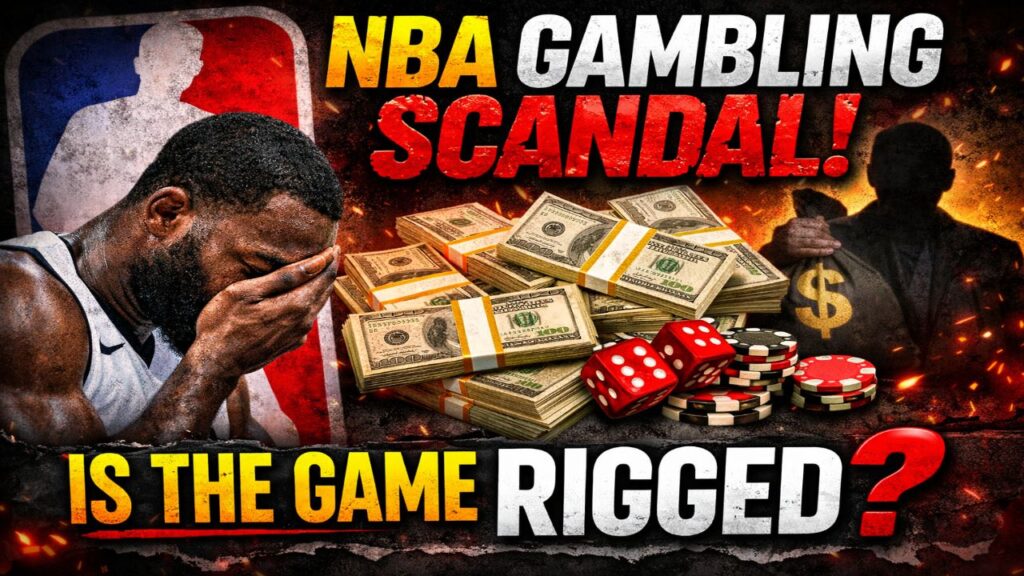
The NBA has always sold us a promise. A promise that every bucket matters. That every turnover is real. That the sweat, pain, and pressure you see on the court are untouched by anything except competition. But what if that promise is cracking? What if, behind the bright lights and sold-out arenas, something darker has been quietly growing—something that could shake the foundation of professional basketball itself?
This is not a rumor. This is not a conspiracy theory cooked up by angry fans on social media. This is a story about gambling, inside information, and a league that now finds itself under a microscope it desperately hoped to avoid.
Because right now, the question fans are whispering isn’t “Who’s winning the championship?”
It’s “Can we still trust the NBA?”
For decades, gambling was treated like the NBA’s forbidden fruit. Players were warned. Staff were monitored. Officials were reminded that even the appearance of impropriety could destroy the league’s credibility. The memory of past scandals lingered like a ghost—proof that once trust is broken, it never fully comes back.
And yet, today, the NBA is more closely tied to gambling than ever before.
Sportsbooks are everywhere. Odds scroll across TV screens during live games. Betting partnerships are proudly announced. The league didn’t just open the door to gambling—it invited it inside, gave it a seat courtside, and told fans it was safe.
But here’s the uncomfortable truth: when money starts flowing this freely, temptation follows. And where temptation exists, someone always crosses the line.
It started quietly. A few strange betting patterns. Lines moving in ways that didn’t make sense. Props being hammered with unusual confidence. At first, nobody wanted to say it out loud. After all, the NBA is a global billion-dollar machine. Suggesting something was wrong felt almost disrespectful.
But gamblers noticed. Analysts noticed. And then investigators noticed.
Whispers turned into concern. Concern turned into scrutiny. And scrutiny turned into something the NBA hates more than anything else—questions about integrity.
What fans don’t always realize is how fragile professional sports really are. The product isn’t just basketball. It’s belief. Belief that the game is honest. Belief that outcomes aren’t manipulated. Belief that no one on the inside is quietly profiting while fans scream at their TVs, thinking every missed free throw is just bad luck.
Now imagine finding out that someone might have known a player’s minutes would be limited before the public did. Or that someone might have had access to injury information before it was officially announced. Or worse—someone might have influenced how a game unfolded, not to win, but to cash in.
That’s where this story gets uncomfortable.
Because this scandal isn’t just about players. It’s about access.
In the modern NBA, information is currency. Who’s resting. Who’s playing through injury. Who’s on a minutes restriction. Coaches, trainers, medical staff, front-office employees—these people know things hours or even days before fans and sportsbooks do.
Now ask yourself one simple question:
If you had that information, and you knew millions of dollars were being wagered every night… would everyone stay clean?
The league wants you to believe the answer is yes.
But history tells us otherwise.
As investigations deepened, it became clear this wasn’t about one bad actor making a stupid decision. This was about a system that made abuse possible. When betting lines shift dramatically just before tip-off, it raises red flags. When obscure player props suddenly attract massive action, it raises eyebrows. When patterns repeat, it raises alarms.
And those alarms are ringing now.
Fans are divided. Some refuse to believe the NBA could ever let something like this happen. Others say this was inevitable the moment gambling became normalized. Social media is on fire with theories, accusations, and debates that feel less like sports talk and more like courtroom arguments.
And the worst part?
Every close game now feels suspicious.
That missed defensive rotation. That star sitting out the fourth quarter. That late foul call. Moments that once sparked normal basketball arguments now spark something darker: doubt.
Because once fans start questioning motives instead of performance, the damage spreads fast.
The league has responded, of course. Statements have been released. Policies reiterated. Assurances made. But to many fans, it feels familiar. Too familiar. Like damage control rather than transparency.
And transparency is exactly what people are demanding.
Behind the scenes, sources describe a league on edge. Not panicking—but watching closely. Monitoring communications. Reviewing betting data. Quietly tightening internal rules while publicly projecting calm. Because the NBA understands something very important: even if wrongdoing is limited, perception alone can be devastating.
Just ask the fans.
Talk to someone who lost money on a bet that suddenly felt “off.” Talk to someone who noticed a line move seconds before breaking news. Talk to longtime viewers who now say they watch games differently, wondering if what they’re seeing is real competition or something else.
That’s the real cost of this scandal. Not legal consequences. Not fines. Not suspensions.
It’s trust.
And trust, once cracked, doesn’t magically repair itself.
What makes this situation even more dangerous is timing. The NBA is more global than ever. More watched. More bet on. A single controversy doesn’t stay contained—it explodes across continents. Fans in different countries, different time zones, different cultures are all asking the same thing.
Is the game fair?
And here’s where it gets even more complicated.
Because not everyone involved has to be corrupt for the system to fail. Sometimes all it takes is one leak. One conversation. One person deciding to share information that should have stayed private. In a gambling ecosystem this large, even a small advantage can become incredibly profitable.
That’s what scares people.
Not that the NBA is rigged.
But that it might be vulnerable.
The league now stands at a crossroads. It can continue to embrace gambling while insisting its safeguards are enough—or it can confront the uncomfortable reality that those safeguards may not be strong enough anymore.
Stricter rules will come. More monitoring. More education. More penalties. But will that be enough to convince fans that nothing shady is happening behind closed doors?
Because fans aren’t stupid. They know money changes behavior. They know temptation exists. And they know sports history is full of examples where people swore “this could never happen here.”
Until it did.
This scandal, whether it grows larger or quietly fades, has already changed the conversation. Every future controversy will be viewed through this lens. Every questionable decision will be analyzed not just as a basketball move, but as a potential financial one.
And that’s dangerous territory for any sport.
The NBA built its empire on stars, storylines, and spectacle. But beneath all of that lies a simple, fragile promise—that what happens on the court is pure competition.
Right now, that promise is being tested.
And how the league responds in the coming months may define its reputation for years to come.
So the real question isn’t whether gambling belongs in basketball anymore. That door is already open.
The real question is this:
Can the NBA protect the game… before fans stop believing in it altogether?
And now I want to hear from you.
Do you think this scandal is being overblown?
Or is this just the beginning of something much bigger?
Drop your thoughts in the comments, because this conversation is far from over.
Also Read: Latest Trending News