The NBA has always sold itself as more than just a game. It’s been marketed as competition at the highest level, a league built on trust, fairness, and the belief that what we see on the court is real, unscripted, and earned. But today, that belief is shaking. Not because of a bad call. Not because of a missed foul. Not because of a superstar demanding a trade. This time, it’s something far more dangerous. Something that threatens the very foundation of professional basketball. Gambling. And not fans betting from their couches — insiders, information leaks, and money moving in the shadows.
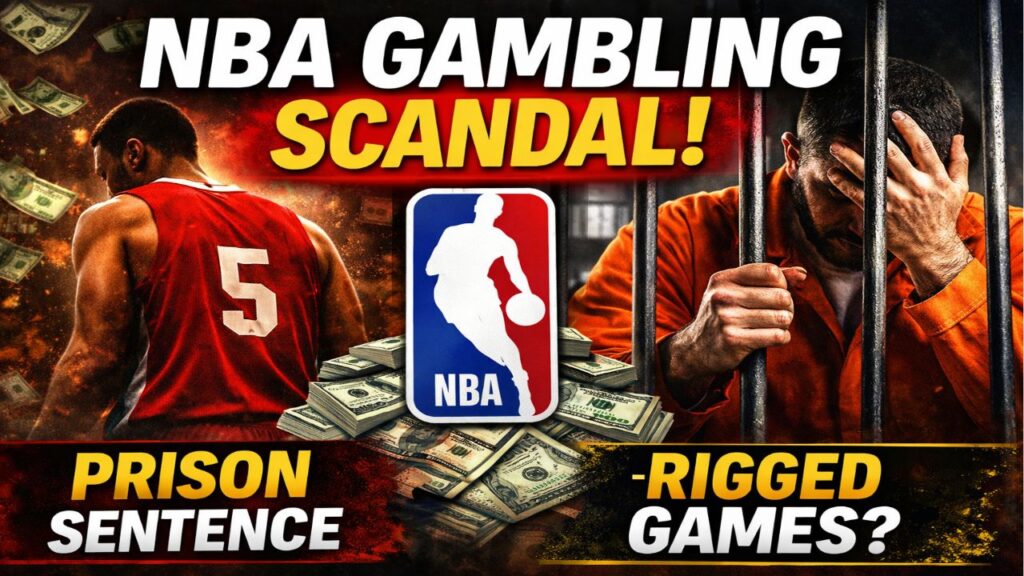
Recently, the first defendant connected to an NBA gambling scandal was sentenced to prison. That sentence might sound like just another crime story, but it could be the crack that opens the entire dam. Because this case isn’t about one person. It’s about how close sports betting has moved to the heart of the NBA, and how impossible it’s becoming to separate competition from corruption. When money, access, and influence collide, the sport doesn’t just risk embarrassment — it risks losing credibility forever.
For decades, gambling was treated like the NBA’s biggest enemy. The league kept it at arm’s length, publicly condemning it while quietly fearing it. Players were warned. Staff were monitored. Referees were scrutinized. Then something changed. Betting became legal, mainstream, celebrated. Sportsbooks partnered with teams. Odds were discussed on broadcasts. Analysts talked spreads and player props like they were box scores. The league didn’t just allow it — it embraced it. And that’s where the problem begins.
Because when betting becomes part of the ecosystem, temptation follows. When people with insider access realize how much money can be made from a single piece of information, the line between right and wrong starts to blur. A minutes restriction. A “rest” decision. A quiet injury. A coach’s rotation plan. These details may seem small, but in the betting world, they are gold. And someone, somewhere, always wants to sell gold.
The sentenced defendant wasn’t a star player. That’s what makes this even scarier. This case proves you don’t need to be LeBron James or Stephen Curry to influence the betting market. You just need access. You need proximity. You need information before the public gets it. And the NBA is full of people who have that kind of access every single day. Trainers. Analysts. Video staff. Security. Friends. Family. The league’s inner circle is bigger than fans want to admit.
Once news of the sentence broke, the reaction online was instant. Some fans shrugged it off, saying this happens in every sport. Others went nuclear, claiming the NBA is already compromised. And that reaction matters, because perception is everything. If fans believe games are influenced by betting, even slightly, the emotional connection is gone. The magic disappears. Nobody wants to watch a game if they think the outcome might be nudged by money instead of skill.
This scandal has reopened an uncomfortable question the NBA hoped would stay buried. How clean is the game right now? Not in theory. Not in official statements. But in reality. When betting companies are sponsors. When odds are pushed during broadcasts. When gambling apps notify users in real time. The league can’t pretend it’s neutral anymore. It built this environment. And now it has to control it.
The most disturbing part isn’t what we know. It’s what we don’t. This is the first sentencing, not the last chapter. Investigations don’t stop at one name. They follow money. They follow patterns. They look for unusual betting activity, suspicious line movements, and repeated anomalies. And history tells us one thing very clearly — scandals like this never stay small. They spread. They grow. They reveal more players, more connections, more uncomfortable truths.
Fans remember what happened in other sports. Referees fixing games. Players shaving points. Entire leagues losing trust overnight. Those leagues survived, but they were never the same. The NBA has spent decades building a global brand, expanding internationally, dominating social media, and creating superstar narratives. All of that is at risk if even a fraction of games are perceived as manipulated.
And here’s the brutal truth — the NBA doesn’t need games to be fixed for the damage to be done. It only needs fans to believe that fixing is possible. Once that doubt exists, every missed shot becomes suspicious. Every late foul becomes questionable. Every coaching decision feels shady. Fans stop arguing about basketball and start arguing about conspiracies.
What makes this situation even more explosive is timing. The NBA is at peak popularity in the betting era. Younger fans are more involved in gambling than ever before. Player prop bets are more popular than team wins. People care more about individual stat lines than final scores. That creates a perfect storm. If a player suddenly plays fewer minutes or underperforms, it doesn’t just affect the game — it affects thousands of bets instantly.
Now imagine being someone on the inside. Imagine knowing a star is on a minutes restriction that hasn’t been announced yet. Imagine knowing a player tweaked something in warmups. Imagine knowing a coach plans to rest someone unexpectedly. That information, shared with the wrong person, can swing millions. And once money starts flowing, it doesn’t stop at one tip. It becomes a system.
The NBA insists it has safeguards. Monitoring systems. Integrity units. Partnerships with regulators. And maybe it does. But no system is perfect. Especially when human greed enters the picture. Especially when salaries vary wildly across league employees. Especially when someone realizes they can make in one night what they earn in a year.
This sentencing sends a message, but it also raises a fear. How many people weren’t caught? How many bets went unnoticed? How many games were influenced in subtle ways that will never be proven? These are questions the league can’t fully answer, and fans won’t stop asking.
Some defenders argue that betting doesn’t affect outcomes, only perception. That players still want to win. That coaches still compete. That pride outweighs profit. And maybe that’s true for superstars. But the league isn’t just superstars. It’s role players fighting for contracts. It’s bench players trying to stay in the league. It’s staff members trying to survive in a high-pressure environment. Everyone has a price, even if they don’t admit it.
The real danger isn’t a superstar throwing a game. It’s subtle manipulation. A late substitution. A delayed return. A strategic rest disguised as caution. These things happen naturally in basketball, which makes them impossible to prove as intentional. That’s why gambling scandals are so hard to kill. They hide inside plausible decisions.
This is why fans are nervous. Because once you see the possibility, you can’t unsee it. Every blowout. Every surprise loss. Every unexpected performance feels different. The joy of the game turns into suspicion. And that’s the worst outcome for any sport.
The NBA now stands at a crossroads. It can treat this as an isolated incident and move on, hoping fans forget. Or it can confront the issue head-on, tighten rules, increase transparency, and draw a hard line between competition and betting. That choice will define the league’s future.
Some are already calling for stricter punishments. Lifetime bans. Zero tolerance policies. Expanded investigations. Others say the league needs to reduce its public association with gambling altogether. Less promotion. Less integration. Less normalization. Because the more betting feels like part of the game, the harder it becomes to separate the two.
But there’s another uncomfortable angle — money. Gambling partnerships are incredibly profitable. They bring in massive revenue. Cutting ties isn’t easy when billions are involved. That’s why fans are skeptical. Because when profit and integrity collide, history shows integrity usually loses.
This scandal also puts pressure on players. Even innocent ones. They’ll be questioned. Watched. Accused online. Social media doesn’t wait for facts. A bad shooting night can turn into conspiracy theories overnight. And once a narrative forms, it sticks.
The NBA built its modern era on trust in its stars. From Jordan to Kobe to LeBron, fans believed what they were watching was pure competition. That belief is priceless. And it’s fragile. One scandal won’t destroy it, but repeated ones will.
This sentencing is not the end of the story. It’s the beginning of a larger conversation that the NBA can no longer avoid. A conversation about how close is too close. About whether the league went too far too fast. About whether the game can stay clean in a world where every possession has a price.
Fans will keep watching — for now. But they’ll also keep questioning. And once fans start questioning, the league has already lost something it can never fully get back.
The real question isn’t whether gambling will hurt the NBA. It already has. The question is whether the league can regain control before the damage becomes permanent. Because once fans stop believing, no amount of highlights, superteams, or storylines can bring that belief back.
And that’s why this story matters. Not because one person went to prison. But because it exposed how thin the line really is between the game we love and the business that profits from it.
Also Read: Latest Trending News