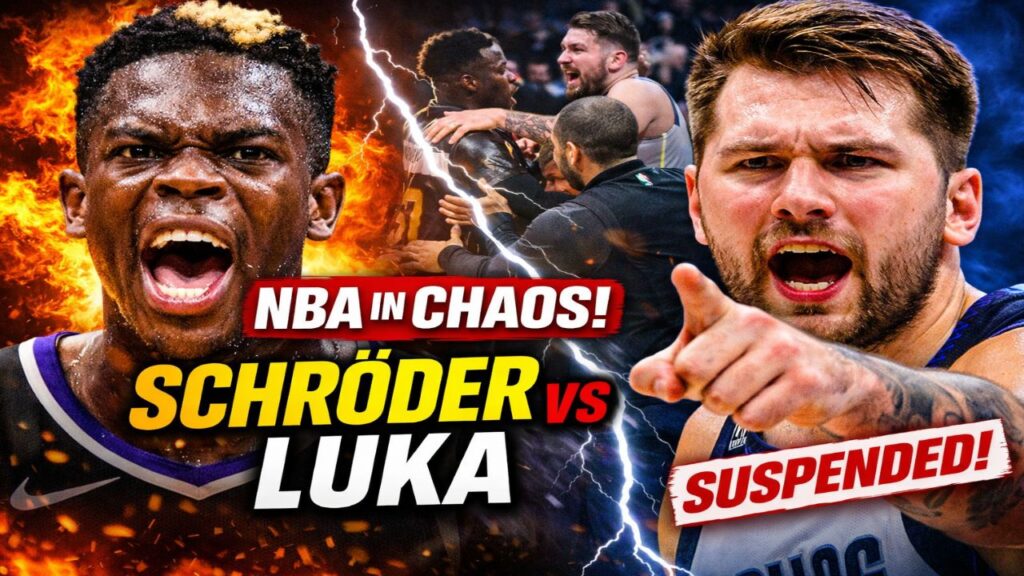
The NBA has always thrived on rivalry, but every once in a while, something happens that feels different, something that goes beyond the normal chest-thumping and trash talk. That is exactly what fans felt when news broke that Dennis Schröder had been suspended after a heated confrontation involving Luka Dončić. At first glance, it sounded like just another altercation in a league full of intense personalities, but once the details started leaking out, people realized this wasn’t just about two players exchanging words. This was about ego, respect, power, and the invisible lines players are not supposed to cross. And once those lines are crossed, the NBA reacts fast, sometimes brutally, because the image of the league is always at stake.
What made this situation explode was the fact that Luka Dončić isn’t just any player. He is one of the faces of the modern NBA, a global superstar with millions of fans who see him as the future of the league. Dennis Schröder, on the other hand, is known for his fire, his attitude, and his refusal to back down from anyone. That combination is dangerous. You mix an outspoken, fearless competitor with a generational superstar, and it only takes one spark to start a wildfire. That spark came during what should have been just another competitive matchup, but instead it turned into one of the most talked-about moments of the season.
The game itself was already intense before anything went wrong. Both teams were fighting for positioning, every possession felt heavy, and emotions were running high. Luka was doing what Luka always does, controlling the pace, hitting tough shots, talking to refs, and getting under the skin of defenders. Schröder was matched up against him for long stretches, and if you know Dennis Schröder, you know he never plays quietly. He’s always chirping, always pushing, always trying to mentally break his opponent. That’s part of his identity as a player. But this time, something snapped.
According to what players on the floor later hinted at, the trash talk went from normal competitive banter to something far more personal. There are lines in the NBA that are unspoken but universally understood. You can talk about someone’s game, their missed shots, their defense, their stats. But once it becomes personal, once it touches family, background, or identity, it changes everything. That’s when tempers flare and restraint disappears. Luka and Schröder were jawing at each other nonstop, and by the fourth quarter, the tension was so thick you could almost feel it through the screen.
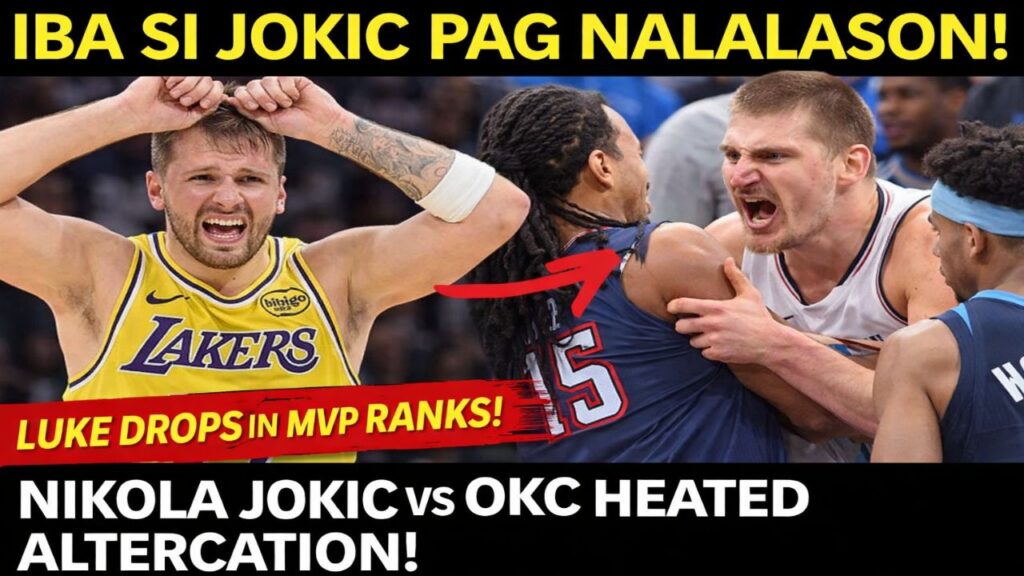
Then it happened. A hard foul, a stare, and suddenly Schröder was in Luka’s face. Teammates rushed in, referees tried to separate them, and the arena buzzed like it was about to explode. Fans watching at home didn’t just see two players arguing. They saw something raw, something emotional, something that felt like it could go way beyond basketball. And when the final whistle blew, people assumed it was over. But it wasn’t. Not even close.
What turned this from a heated moment into a league-wide controversy was what reportedly happened after the game. Normally, players go to the locker room, emotions cool down, and whatever happened on the court stays there. But this time, Schröder allegedly confronted Luka again, and that is where the NBA draws a hard line. On-court trash talk is part of the game. But once you carry it into private areas, into hallways, locker rooms, or player spaces, it becomes a serious violation. The league sees that as threatening behavior, even if no punches are thrown.
When the news of Schröder’s suspension dropped, fans immediately split into two camps. One side said the NBA was protecting its golden boy, Luka Dončić, and making an example out of Schröder. The other side argued that Schröder crossed a line that can’t be ignored, no matter who he was confronting. That debate alone fueled millions of comments, tweets, and reaction videos. Everyone had an opinion, and that’s exactly why this story went viral so fast.
For Schröder, this moment hit especially hard because he has always been seen as a player who plays with a chip on his shoulder. He’s bounced around the league, sometimes praised, sometimes criticized, often underestimated. That creates a mindset where you feel like you constantly have to prove yourself. When someone like Luka, who is adored by fans and protected by the league’s image machine, is on the other side, it can feel unfair. That doesn’t justify crossing lines, but it helps explain why emotions boiled over.
From Luka’s perspective, this wasn’t just about being targeted by a defender. Luka is known for his own trash talk, his own emotional outbursts, and his constant arguments with referees. He isn’t innocent in the world of NBA drama. But when someone takes things off the court, that’s when even the toughest stars feel threatened. No one wants to deal with that kind of confrontation when cameras are off and security is thinner. That’s why the league reacted quickly, sending a message that off-court confrontations will not be tolerated.
The NBA is in a strange place right now. On one hand, it wants to market passion, rivalries, and emotion because that’s what fans love. On the other hand, it has to maintain an image of professionalism, safety, and control. When players go too far, especially in ways that look aggressive or threatening, the league worries about lawsuits, bad press, and sponsors getting nervous. So suspensions become a way to show that they’re in charge, even if fans don’t always agree with the decisions.
This incident also brought back old conversations about double standards in the NBA. Fans pointed out that star players often get more protection than role players. They wondered if Schröder would have been suspended as quickly if he had confronted someone who wasn’t as important as Luka Dončić. That question alone sparked hours of debates on sports shows and podcasts. Some people argued that the league always protects its biggest stars because they bring in the money. Others said the evidence of an off-court confrontation was enough to justify the punishment, regardless of who was involved.
What makes this story even more fascinating is how it affects both teams moving forward. Schröder’s suspension meant his team had to play without a key rotation guard, someone who brings energy, defense, and leadership. Losing him, even for a few games, can swing outcomes in a tight playoff race. Meanwhile, Luka’s team now has to deal with the emotional aftermath of knowing their superstar was at the center of a major controversy. That kind of attention can be distracting, even if Luka himself tries to brush it off.
Inside locker rooms around the league, players were watching closely. Not because they cared about Schröder and Luka personally, but because this set a precedent. It told them how far they can go before the league steps in. Trash talk is part of the culture, but this incident made it clear that once things leave the court, the consequences become severe. Veterans warned younger players to be careful. Coaches reminded their teams to walk away, no matter how angry they feel in the moment.
Fans, of course, saw it very differently. To many of them, this was exactly the kind of raw drama that makes the NBA exciting. They didn’t want sanitized, corporate-friendly basketball. They wanted real emotion, real conflict, and real stakes. Schröder vs Luka felt like something out of an old-school rivalry, the kind that used to define the league in its grittier eras. That’s why so many people felt disappointed that it ended with a suspension instead of just being handled between the players.
Social media poured fuel on the fire. Clips of the confrontation were slowed down, zoomed in, analyzed frame by frame. People tried to read lips, guess what was said, and decide who was at fault. Memes spread everywhere, some supporting Schröder, some mocking him, some defending Luka. In today’s NBA, a moment like this doesn’t just live for a night. It becomes a digital storm that lasts for weeks, shaping how players are viewed long after the games are over.
For Schröder, this could become a defining moment in his career. Not because of the suspension itself, but because of how people will remember it. Some will see him as the guy who stood up to a superstar and refused to be intimidated. Others will see him as someone who lost control and hurt his own team. In a league where perception can be just as important as performance, that matters a lot.
For Luka, the situation is just another chapter in his growing legend. He’s already known as a fiery competitor who draws both admiration and frustration. This incident adds another layer to that story. It shows that he’s not just dominating on the court, but also influencing the emotional dynamics of the game around him. Whether people love him or hate him, they’re talking about him, and in the modern NBA, that kind of attention is powerful.
As the season moves forward, this rivalry is far from over. The next time these two teams meet, every camera will be focused on Schröder and Luka. Every glance, every bump, every word will be analyzed. That’s how NBA drama works. One moment turns into a storyline, and that storyline turns into ratings, clicks, and endless debate. The league might try to move on, but fans won’t forget.
This is why the Schröder vs Luka controversy feels so much bigger than a simple suspension. It represents the tension between emotion and control, between old-school intensity and modern league image. It shows how quickly a single moment can turn into a league-wide conversation. And most of all, it proves that in the NBA, the biggest battles aren’t always just about points on a scoreboard. Sometimes, they’re about pride, respect, and who refuses to back down when things get uncomfortable.
And that’s exactly why this story went viral. Not because someone got suspended, but because everyone could see themselves in it. The competitor who won’t stay silent. The superstar who won’t be disrespected. The league trying to keep everything under control while the fire keeps burning. This wasn’t just a fight. It was a clash of personalities, power, and the future of how the NBA wants to be seen.
And trust me, this won’t be the last time we hear about it.
Also Read: Latest Trending News