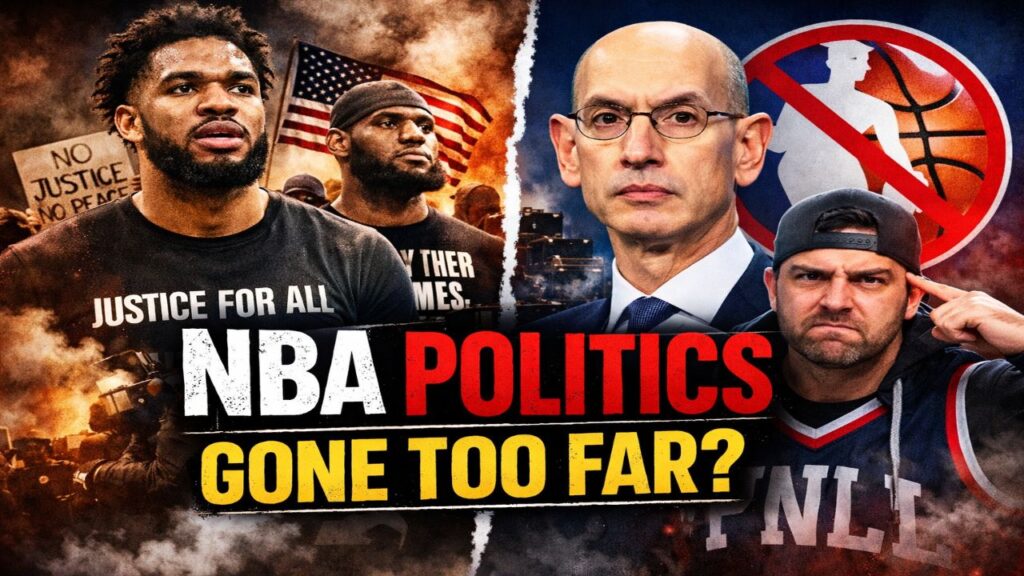
The NBA has always sold itself as more than just basketball. It’s been marketed as culture, voice, influence, and power. But right now, that very identity is being tested in a way the league hasn’t seen since the bubble days. What started as a single postponed game has now exploded into a league-wide debate that’s dividing fans, media, politicians, and even players themselves. Some are calling it courage. Others are calling it distraction. And a growing number are asking a dangerous question: Has the NBA gone too far this time?
The moment everything shifted was quiet at first. A delay. A statement. A few players choosing not to speak to the media. But underneath that silence was a storm building fast. The National Basketball Players Association released a message that hit like a bombshell — “NBA players can no longer remain silent.” Those words didn’t just echo across social media. They landed inside locker rooms, front offices, TV studios, and living rooms across America. Because this wasn’t about one incident anymore. This was about the league’s soul.
Fans immediately split into two camps. One side applauded the players for standing up, saying this is exactly what leadership looks like in 2026. The other side fired back just as loudly, saying they didn’t tune in for politics, protests, or statements — they tuned in for basketball. And in the middle of it all sat the NBA itself, awkwardly trying to balance its public image, its business interests, and its players’ growing willingness to challenge power.
What makes this controversy different from past moments is timing. The league is deeper into partnerships than ever before — streaming deals, international expansion, gambling sponsorships, and global branding. Every pause, every protest, every headline now has a financial ripple effect. Games aren’t just games anymore. They’re scheduled content blocks worth millions of dollars. So when games get delayed or overshadowed by activism, the question becomes unavoidable: Who really controls the NBA — the league or the players?
Inside locker rooms, the mood isn’t unified like many people assume. Some players feel empowered, believing this is the next step in athlete evolution. Others feel trapped, worried that refusing to participate in activism will label them as silent or complicit. There are players who just want to hoop, who privately admit they feel uncomfortable being pushed into political conversations they didn’t ask for. But in today’s NBA, silence itself has become a statement.
Veteran players remember how different this league used to be. Decades ago, speaking out could cost you endorsements, minutes, or even your career. Today, stars are brands, and brands speak. But that doesn’t mean there aren’t consequences. Behind closed doors, executives are reportedly furious. Networks are nervous. Sponsors are watching sentiment shift in real time. And the league office is walking a tightrope thinner than ever before.
The NBA likes to present itself as progressive, but progress becomes complicated when it interrupts the product. Fans are asking why certain games were delayed while others went on. Why some teams spoke out while others stayed quiet. Why the league appears inconsistent, reactive, and at times completely unprepared. Consistency matters in credibility, and right now, critics say the NBA doesn’t have it.
Social media has turned this controversy into a wildfire. Clips are being taken out of context. Statements are being dissected word by word. One sentence from a player can spark a week-long debate. Talk shows thrive on it. Algorithms reward outrage. And suddenly, basketball analysis takes a backseat to ideological warfare. Highlights are buried beneath arguments.
What’s really fueling the anger, though, is fatigue. A large portion of the fanbase feels exhausted. They’ve lived through pandemics, economic stress, global conflicts, and nonstop political noise. For them, sports were supposed to be an escape. When that escape starts feeling like another battleground, frustration boils over. These fans aren’t necessarily against the message — they’re against the timing, the delivery, and the feeling of being lectured.
On the flip side, supporters of the players argue that expecting athletes to shut up and entertain is outdated and unfair. These are human beings, many from communities directly affected by the issues being discussed. They argue that the NBA platform is precisely what gives these messages power. To them, telling players to “stick to basketball” sounds less like neutrality and more like suppression.
The league’s history makes this debate even messier. The NBA has previously embraced social justice messaging, marketed it, and benefited from the cultural credibility it brought. Jerseys, court slogans, promotional videos — all of it was celebrated when it aligned with public sentiment. But now that the climate has shifted and backlash is louder, critics accuse the league of wanting the image without the inconvenience.
Owners are in a particularly awkward position. Many publicly support player expression while privately worrying about long-term damage. Empty seats don’t trend on Twitter, but they hurt in real life. Ratings drops don’t go viral, but advertisers notice. And while star players have leverage, role players don’t always have the same safety net. That imbalance creates tension no one wants to talk about openly.
This controversy also exposes a generational divide. Younger fans are more likely to support player activism, seeing it as normal and necessary. Older fans are more likely to feel alienated, feeling like the game they grew up loving has been transformed into something unfamiliar. Neither side feels heard, and both believe the league is choosing the other.
Media personalities have poured gasoline on the fire. Some accuse players of hypocrisy, pointing out selective outrage. Others accuse critics of racism, fear, or ignorance. Nuance gets lost because nuance doesn’t trend. Loud takes do. Extreme positions do. And so the cycle continues — outrage feeds content, content feeds outrage.
What’s especially dangerous is the precedent being set. If games can be delayed or overshadowed by statements today, what happens tomorrow? What’s the line? Who decides when a moment is “important enough”? Without clear guidelines, every situation becomes a negotiation under pressure. And in a league built on structure, uncertainty is poison.
There’s also the international angle. The NBA isn’t just American anymore. It’s a global product watched in dozens of countries with very different political landscapes. Messages that resonate in one place may alienate audiences elsewhere. Global growth has been one of the league’s biggest victories, but controversies like this test how universal its messaging really is.
Players themselves are feeling the weight. Being expected to comment on complex social issues after a tough loss or before a big game isn’t easy. Some are well-read and passionate. Others are not. And when a poorly worded statement goes viral, there’s no undo button. The internet doesn’t care about context or intention.
Behind the scenes, PR teams are scrambling. Statements are being rewritten. Talking points are being distributed. Damage control is constant. And yet, the more the league tries to manage the narrative, the more critics accuse it of being fake or calculated. Authenticity is demanded, but authenticity is risky.
The biggest question looming over all of this is sustainability. Can the NBA continue down this path without losing a significant portion of its audience? Or is this simply the uncomfortable transition period toward a new normal? History shows that leagues survive controversy, but they don’t escape unscathed.
Some insiders believe this moment will force the NBA to finally draw clearer boundaries — to define what player expression looks like during official league events versus personal platforms. Others believe any attempt to limit speech will be seen as betrayal and spark even bigger backlash. Either way, the days of ambiguity are numbered.
What’s undeniable is that this controversy has changed the conversation. It’s no longer just about basketball strategy, trades, or championships. It’s about power, voice, responsibility, and identity. The NBA is no longer just reacting to culture — it’s shaping it, for better or worse.
And the fans are watching closely. Some will stay. Some will leave. Some will argue endlessly in comment sections. But everyone will remember this moment as a turning point — the time when the league had to choose between being purely entertainment or something more complicated.
The truth is uncomfortable: there is no outcome where everyone wins. Supporting players risks alienating fans. Silencing players risks alienating the stars that make the league valuable. Doing nothing risks looking weak. Doing too much risks looking performative. Every option comes with consequences.
So as the season moves forward, every game will carry more than just a score. Every press conference will be analyzed. Every silence will be questioned. The NBA isn’t just playing basketball anymore — it’s playing a high-stakes game of perception.
And the final outcome? It won’t be decided by a buzzer-beater or a championship trophy. It will be decided by whether fans still feel connected when the noise dies down. Whether players still feel heard without feeling used. And whether the league can survive being both a mirror of society and an escape from it at the same time.
Because once sports stop being just sports, there’s no going back.
Also Read: Latest Trending News