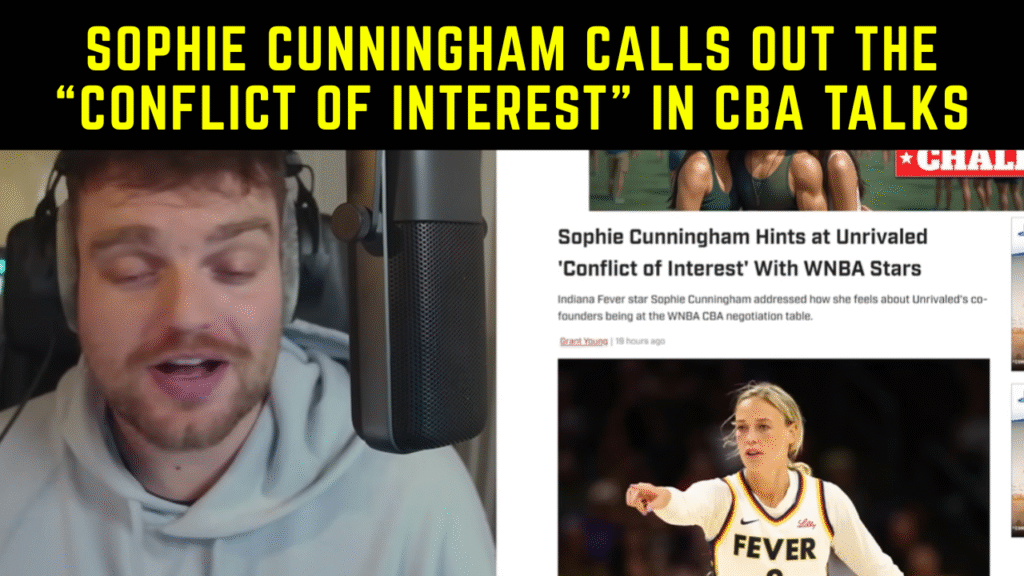
Sophie Cunningham calls out a major conflict of interest in WNBA CBA talks involving Unrivaled’s player-owners. Here’s why her comments have sparked serious conversation across the league.
Sophie Cunningham didn’t hold back.
The Indiana Fever guard said what a lot of players — and fans — have quietly been thinking: that there’s a real conflict of interest when the same players who co-own Unrivaled, a new player-run basketball league, are also sitting at the table negotiating the WNBA’s next Collective Bargaining Agreement.
Her comments have lit up discussions across social media, podcasts, and locker rooms — because for once, a current player said out loud what many have only whispered.
“She Said What We All Know”
On her show, Sophie spoke candidly about how odd it feels to see people representing the players’ union while simultaneously running a rival league.
“They’re phenomenal players,” Sophie said, referring to Breanna Stewart, Napheesa Collier, and Nneka Ogwumike — all of whom hold major roles in both the WNBPA and Unrivaled.
“But they’re also part of the exec board. That could be a little conflict of interest because… well, they’re Unrivaled.”
That’s the moment fans knew she wasn’t mincing words. Sophie wasn’t attacking anyone personally — she was pointing out a very real dilemma.
The Core Issue: Dual Loyalties
Let’s be honest — Sophie’s not wrong.
When players who own a league are negotiating terms that could directly impact that league, it’s tricky.
Imagine the WNBA owners offering a massive salary bump — say, $3 million max contracts, full charter flights, and fair revenue sharing — but with one big condition: no offseason play in outside leagues like Unrivaled or Project B.
That would be a dream deal for 200+ WNBA players, but a nightmare for Unrivaled’s founders, whose business depends on those same athletes participating.
So whose interests come first at the table — the collective players’ or the league founders’?
That’s exactly what Sophie’s questioning.
“It Doesn’t Mean Unrivaled Is a Bad Thing”
What makes Sophie’s take balanced is that she never said Unrivaled is the problem. In fact, she praised it.
Unrivaled could be a huge step forward — an athlete-led project giving players more control over their careers and visibility in the offseason. But when its co-owners are also key voices in shaping the WNBA’s financial future, things get messy.
Cunningham clarified:
“It’s not that Unrivaled is bad… it’s just that it becomes impossible to separate personal interests from the bigger picture.”
And she’s right — it’s not malicious. It’s human nature. When people have personal stakes, total objectivity is hard to maintain.
The WNBA’s Perspective
The WNBA itself has every reason to be cautious. The league’s already lost players to other ventures and overseas leagues.
They’ve introduced prioritization rules to keep stars from skipping WNBA seasons for better-paying international gigs.
Now, with Unrivaled and Project B entering the scene, it’s only natural that the league would want to protect its brand, its players, and its schedule.
But that protection comes with a trade-off: how much independence are players willing to give up for financial security?
“If the League Pays Fairly, They Have a Right to Expect Loyalty”
That’s another point Sophie made subtly but powerfully.
If WNBA owners start paying players 2–3 million per year, offer charters, and improve conditions — they’d have every right to expect players to prioritize the WNBA season exclusively.
It’s a logical trade-off:
- Higher pay, more commitment.
- No overseas distractions.
- No rival league conflicts.
But the problem is — the ones negotiating for “player freedom” might also be the ones losing business if players can’t do Unrivaled anymore.
That’s where Sophie’s “conflict of interest” argument hits hardest.
Why Sophie’s Honesty Matters
Let’s be real — it takes guts for an active WNBA player to question leadership publicly. The league’s small. Everyone knows everyone. And yet, Sophie put it all out there.
She didn’t say anyone was corrupt or dishonest. She simply said the quiet part out loud — that it’s really hard to separate personal gain from collective bargaining when your business ventures overlap.
That transparency is refreshing. And it’s exactly the kind of conversation women’s basketball needs if it’s going to keep growing in an honest, sustainable way.
What Happens Next
The WNBPA will continue CBA talks in the coming months, and the tension between player empowerment and league loyalty will only get sharper.
Unrivaled is set to debut soon, and Sophie’s comments may spark other players to ask hard questions about representation, fairness, and priorities.
At the end of the day, no one’s saying Unrivaled shouldn’t exist.
They’re just saying: maybe the people building a rival league shouldn’t be the same ones negotiating for the WNBA’s future.
And that’s a conversation worth having — not just in private, but out loud.
Also Read: Latest Trending News