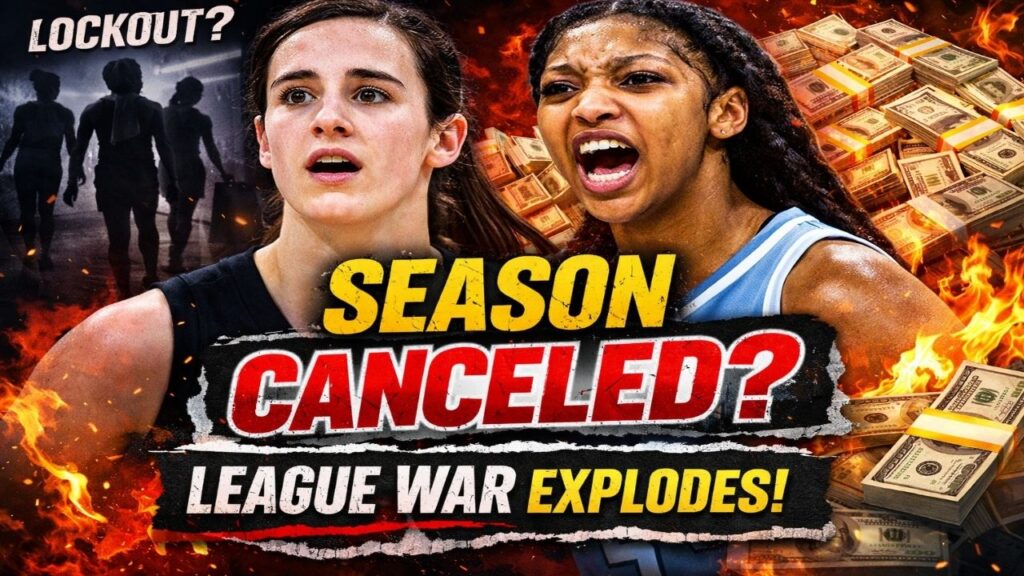
The WNBA is standing on a cliff right now, and most fans don’t even realize how close the league is to falling. On the surface, everything looks normal. Caitlin Clark is still breaking records. Angel Reese is still dominating headlines. Arenas are still packed. Jerseys are still selling out. But behind the scenes, something far more dangerous than any rivalry is quietly unfolding. A labor war. One that could freeze free agency, cancel games, and even wipe out an entire season if it explodes the wrong way. And what makes this situation so explosive is not just money. It’s power, respect, and a league that is finally realizing just how valuable its stars really are.
For years, WNBA players were told to be patient. They were told the league was still growing. They were told the revenue wasn’t there yet. They were told to accept lower salaries because the business couldn’t afford more. But then something changed. Suddenly, the arenas were fuller than ever. TV ratings skyrocketed. Social media engagement went insane. And a new generation of stars arrived that pulled in millions of fans who had never even watched women’s basketball before. Caitlin Clark didn’t just bring skill. She brought eyeballs. Angel Reese didn’t just bring rebounds. She brought controversy, personality, and nonstop viral moments. Together, they didn’t just elevate the league. They forced the world to pay attention.
And that’s where the tension began.
Because when a league grows this fast, someone always starts asking uncomfortable questions. Who is really benefiting? Where is the money actually going? And why do the people putting on the show feel like they’re still being treated like an afterthought?
This is where the WNBA’s collective bargaining agreement enters the story. The CBA is basically the contract that defines everything. How much players get paid. How revenue is shared. How free agency works. How long contracts last. How travel is handled. How injuries are compensated. How much power players have versus owners. It’s the backbone of the entire league. And when that agreement expires or breaks down, chaos follows.
That’s exactly what is happening right now.
The deadline for a new CBA quietly passed. No celebration. No announcement. No breakthrough. Just silence. And in professional sports, silence is usually the loudest warning sign you can get. Because when negotiations stall at this level, it means both sides are dug in, and neither side wants to blink.
The WNBA players’ union knows something the league can no longer hide. The WNBA is not the same league it was five years ago. It is not a niche product anymore. It is a brand. It is a cultural force. It is a social media machine. And most importantly, it is profitable in ways it never used to be. Merchandise sales are exploding. Broadcast deals are growing. Sponsors are lining up. Stars are becoming household names. This is not the struggling league of the past.
So players are asking a simple question. If the league is booming, why aren’t the players sharing in that boom?
That question terrifies ownership.
Because once players demand a bigger piece of the pie, the entire business model changes. Suddenly, the league can’t hide behind development excuses. Suddenly, the books matter. Suddenly, every sponsorship, every ticket sale, every streaming deal becomes part of the argument. And the players are no longer willing to accept crumbs while their jerseys sell out worldwide.
The WNBA players are reportedly demanding a massive increase in revenue sharing. Not small raises. Not symbolic gestures. They want a real percentage of what the league makes. They want higher salary caps. They want max contracts that actually reflect superstar value. They want benefits that match the grind they endure. And most importantly, they want respect that goes beyond marketing slogans.
From the players’ perspective, this isn’t greed. This is correction.
Because for decades, women’s sports were underpaid not because they lacked talent, but because they lacked exposure. Now the exposure is here. The fans are here. The money is here. So why should the contracts still look like it’s 2010?
But from the league’s perspective, this is terrifying.
Because even though revenue has grown, profitability is still fragile. The WNBA doesn’t have the same financial cushion as the NBA. One bad year can hurt. One bad deal can destabilize the league. And locking in massive long-term player costs without certainty could push teams into real financial trouble. The league knows this. And that’s why they are pushing back hard.
This is where the standoff becomes dangerous.
When players feel underpaid, they get angry. When leagues feel financially threatened, they get stubborn. And when both sides stop trusting each other, everything freezes.
That’s exactly what happened with free agency.
WNBA free agency has been placed into a holding pattern. Deals are not moving. Contracts are not being finalized. Players don’t know where they’ll be playing. Teams don’t know who they can sign. It’s like the entire league is holding its breath. And the longer this drags on, the closer everyone gets to a lockout.
A lockout means players are not allowed to play. It means games stop. It means no season. It means no pay. It means fans get nothing.
And if that happens in the middle of the Caitlin Clark and Angel Reese era, the damage could be historic.
Think about that for a moment.
The WNBA finally has mainstream attention. Young fans. Viral clips. Sold-out crowds. And just as the league is peaking, it risks tearing itself apart over money. That’s not just bad timing. That’s catastrophic timing.
Caitlin Clark didn’t just bring Iowa fans. She brought millions of casual viewers who never cared about the WNBA before. Angel Reese didn’t just bring LSU fans. She brought culture, drama, and social media energy that made games must-watch events. These two stars, and many others like them, are creating a moment the WNBA has never experienced.
And now that moment is at risk.
Because stars don’t stay quiet when their careers are put on pause. They don’t accept being sidelined over negotiations. They don’t like losing momentum. And if the WNBA drags this out, some of these players will start looking elsewhere. Overseas leagues. Sponsorship-heavy alternatives. Even retirement. The league cannot afford to lose this generation.
But the players also cannot afford to back down.
Because this is their leverage moment. They finally have bargaining power. The league needs them more than ever. And if they don’t push now, they might never get another chance like this again.
So both sides are stuck in a brutal game of chicken.
And the fans are caught in the middle.
Some fans are blaming the players, saying they are asking for too much too fast. Others are blaming the league, saying it is exploiting talent and refusing to adapt to growth. Social media is already splitting into camps. And the longer this goes on, the uglier it gets.
Add to that the already tense atmosphere in the WNBA, and the fire spreads even faster.
The league has been dealing with controversies that already put it under a microscope. From player criticisms of leadership, to bizarre fan behavior, to political and cultural debates that never seem to cool down. The WNBA is not just a sports league anymore. It’s a battleground of opinions, identities, and expectations.
When Sophie Cunningham and Napheesa Collier criticized the commissioner, that wasn’t just frustration. That was a warning. When players talk about respect and communication, they are really talking about power. Who gets to decide. Who gets heard. Who matters.
Now take that tension and drop it into labor negotiations, and you get an explosion waiting to happen.
If this ends in a lockout, the headlines won’t just be about contracts. They’ll be about betrayal. About missed opportunities. About a league that couldn’t get out of its own way. And the biggest tragedy will be that fans who just discovered the WNBA might walk away just as quickly as they came.
Because fans don’t follow legal battles. They follow stars. They follow stories. They follow moments. And if the WNBA goes dark, the moment dies.
That’s why this situation is so dangerous.
The league has never had more to lose, and the players have never had more to fight for.
And that is why this controversy is exploding right now.
This isn’t just about money. It’s about whether the WNBA is ready to accept that it has arrived. Whether it sees itself as a real major league with real superstar economics. Or whether it still wants to operate like a struggling startup that tells its workers to be grateful.
Caitlin Clark, Angel Reese, and the rest of this generation are not waiting quietly. They know their worth. They see the ratings. They see the merch sales. They see the crowds. And they are not going back to being invisible.
The WNBA can either meet them where they are, or it can risk losing everything it just built.
And right now, the clock is ticking.
Because once players start walking, there is no easy way back.
The next few weeks could decide the future of the entire league.
And the scariest part is that almost nobody is talking about it yet.
But soon, everyone will.
Also Read: Latest Trending News