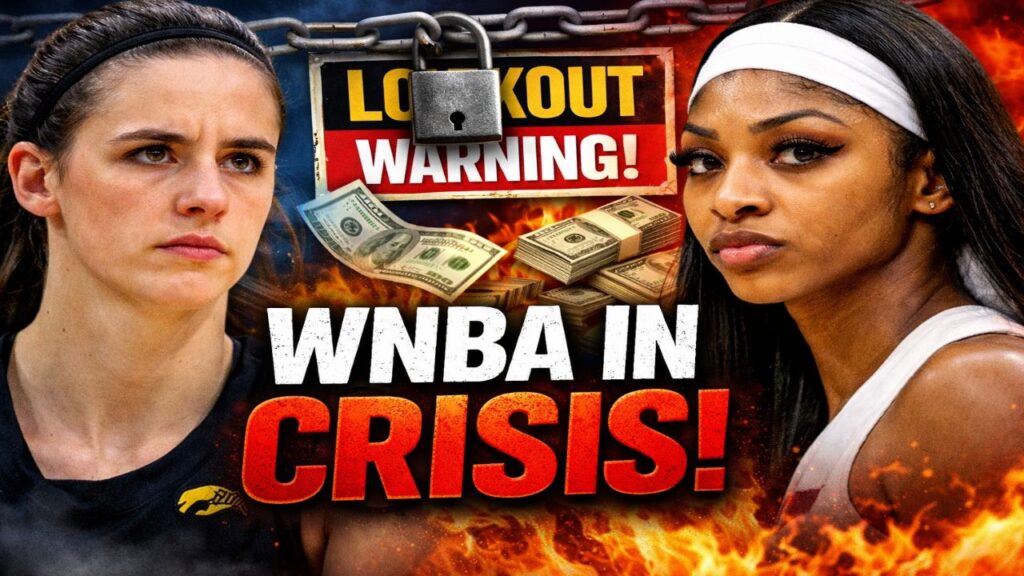
The WNBA has always been a league built on resilience, but right now it’s standing at the edge of something far more dangerous than any tough road trip or losing streak. Behind the scenes, a quiet but explosive battle is unfolding between the league and its own players, and for the first time in years, the future of an entire season is being questioned. Fans see packed arenas, rising TV ratings, and stars like Caitlin Clark and Angel Reese becoming household names. But what they don’t see is the deepening tension in boardrooms, private meetings, and heated negotiations that could rip the league apart. This isn’t just about money. This is about power, respect, and whether the WNBA can survive its own success.
For years, players have fought to grow the league from a niche product into a mainstream sports powerhouse. Now that growth is finally happening. Social media engagement is exploding. Jersey sales are breaking records. National TV broadcasts are bringing in millions of viewers. Caitlin Clark is selling out arenas on the road. Angel Reese has become one of the most recognizable faces in all of sports. Suddenly, the WNBA isn’t just a league. It’s a brand. And when a brand starts making real money, everyone wants a bigger piece of it.
That’s where the problem begins.
The current conflict centers around the collective bargaining agreement, the legal framework that decides everything from salaries to travel conditions to how revenue is shared. For the casual fan, a CBA sounds boring. But in reality, it’s the soul of a sports league. It decides whether players feel valued or exploited. It determines whether owners see athletes as partners or just assets. And right now, the WNBA’s CBA talks have turned into a full-blown standoff.
On one side, you have league executives and team owners who argue that the WNBA is still in a fragile financial position. They claim the league has grown, but it’s not yet as profitable as the NBA or NFL. They say expansion costs money. Marketing costs money. Charter flights, better facilities, and higher salaries all add up. From their perspective, they’re trying to protect the long-term survival of the league by keeping costs under control.
On the other side, you have players who feel they are finally driving real value and aren’t being compensated fairly for it. These athletes see sold-out crowds, viral highlights, and booming merchandise sales, yet their paychecks still look tiny compared to the revenue they help generate. They feel disrespected, especially when they compare themselves to players in men’s leagues who receive massive contracts for far less cultural impact. The frustration has been building quietly for years, and now it’s boiling over.
What makes this situation even more volatile is the timing. The WNBA is in the middle of what many consider its golden moment. Never before have so many eyes been on women’s basketball. Young fans are discovering the sport through TikTok, Instagram, and YouTube. Major brands are lining up for endorsements. The league is finally mainstream. And yet, at the peak of this momentum, everything is at risk because the people who make the league special no longer feel protected by it.
Caitlin Clark has become the face of this new era, whether she wants to be or not. Every time she steps on the court, she draws crowds that rival some NBA games. Her shooting range, her swagger, her competitive fire have made her a phenomenon. But off the court, she has also become a symbol of the new power players hold. Fans don’t tune in just for teams anymore. They tune in for stars. And stars know it.
Angel Reese represents another side of that power. She’s not just a basketball player. She’s a cultural icon. Her personality, her fashion, her social media presence all bring attention to the WNBA that simply didn’t exist before. Together, Clark and Reese are proof that women’s basketball is no longer just about the game. It’s about influence, branding, and global reach. And when players bring that much value, they expect to be treated accordingly.
The tension exploded when players started speaking more openly about leadership inside the league. Some stars questioned whether the commissioner and league office truly understood the moment they were in. Was the WNBA ready to act like a major sports league, or was it still thinking small? That question cut deep. Because to the players, it felt like the league was holding them back instead of pushing them forward.
What makes this controversy so explosive is that both sides believe they are right. League officials see the financial risks. Players see the missed opportunities. And neither side wants to blink first. That’s how labor wars begin.
Fans might think a lockout or strike is just a temporary inconvenience, but it’s much more than that. If games are canceled or delayed, momentum can vanish overnight. Casual fans who just discovered the WNBA might move on to something else. Sponsors might get nervous. TV networks might reconsider their investment. In sports, attention is everything, and once you lose it, it’s incredibly hard to get back.
Social media has made this conflict even more intense. Every leaked comment, every frustrated tweet, every vague Instagram story becomes a headline. Fans pick sides. Some blame the players for being greedy. Others blame the league for being cheap. The truth is, both sides are scared. The league is scared of overspending and collapsing financially. Players are scared of being locked into unfair deals while the money flows around them.
There is also a deeper emotional layer to this story. Many WNBA players have spent their entire careers fighting for respect. They’ve traveled on commercial flights while men flew private. They’ve played in half-empty arenas while male athletes performed in sold-out stadiums. Now that things are finally changing, the idea of settling for less feels like betrayal. They don’t want to be grateful. They want to be equal.
And that’s why this isn’t just a contract dispute. It’s a cultural clash. It’s about how women’s sports are valued in a world that is only now beginning to take them seriously.
The commissioner has found herself in the middle of a storm. Some players believe she hasn’t done enough to capitalize on the league’s popularity. They argue that better marketing, better scheduling, and bolder decisions could have pushed the WNBA even further into the spotlight. Others believe she’s doing the best she can with limited resources. But perception matters. And right now, a growing number of players feel disconnected from the leadership at the top.
This disconnect is dangerous because trust is the foundation of any sports league. When players trust management, they’re willing to compromise. When that trust breaks, every negotiation becomes a battle.
Behind closed doors, these negotiations are brutal. Lawyers argue over percentages. Agents fight for every dollar. Owners worry about budgets. Players worry about their futures. Everyone is calculating, everyone is tense, and everyone knows that one wrong move could trigger chaos.
The worst part is that there might not be a clean winner. If the league gives players everything they want, some teams might struggle financially. If players don’t get what they demand, morale could collapse. Either way, the risk is real.
What makes this moment especially dramatic is how public it has become. In the past, sports labor disputes happened quietly. Now, fans are watching in real time. They’re debating it on social media, making videos, picking heroes and villains. The story has escaped the boardroom and entered the culture.
And culture is powerful.
Young fans who look up to Caitlin Clark and Angel Reese don’t just see athletes. They see role models. If these stars take a stand, it sends a message far beyond basketball. It becomes a statement about fairness, opportunity, and respect. That’s why this conflict resonates so deeply. It’s not just about one league. It’s about how women’s sports are treated in general.
There’s also a fear that this could fracture the league internally. If some players are willing to compromise and others are not, unity could break. Teams could become divided. Locker rooms could feel the strain. That’s how dynasties collapse.
Yet, there is still hope. Labor wars don’t always end in disaster. Sometimes, they lead to breakthroughs. If both sides realize what’s at stake, they might find a way forward that protects the league while honoring the players. A fair revenue-sharing model, better working conditions, and a clearer vision for growth could transform the WNBA into something even bigger than it is now.
But that requires courage. It requires leadership. And it requires honesty.
Right now, the WNBA stands at a crossroads. One path leads to stability, growth, and a future where women’s basketball thrives like never before. The other leads to uncertainty, lost momentum, and a generation of fans who might never come back.
That’s why this story matters so much. It’s not just sports news. It’s history in the making.
When people look back at this moment years from now, they will either say this was when the WNBA finally claimed its place in the sports world, or they will say this was when it let everything slip away. The decisions being made today will echo for decades.
Caitlin Clark and Angel Reese didn’t ask to be at the center of this storm, but they are. Their popularity has changed the league. Their voices carry weight. And whether they speak loudly or quietly, the entire world is listening.
Fans can argue about who’s right and who’s wrong, but one thing is undeniable. The WNBA is no longer invisible. It’s powerful. And power always brings conflict.
The question now is simple, but terrifying. Can the WNBA survive its own success?
Because sometimes, the biggest threat to a league isn’t failure. It’s growth.
And right now, the WNBA is growing faster than anyone ever imagined.
Also Read: Latest Trending News