The WNBA Players Union did not expect this to leak. And that’s the problem. Because once you see the numbers, once you actually read what was put in front of the players behind closed doors, the entire public narrative collapses. This wasn’t a lowball offer. This wasn’t some disrespectful slap in the face. This wasn’t owners being greedy villains while players fight for crumbs. What this was… was an exposure. A full-on mask-off moment. And once fans saw it, the sympathy meter flipped instantly.
For years, we’ve heard the same talking points repeated over and over. The league is growing. The league is exploding. The league is finally here. The money is coming. The stars are bigger than ever. The ratings are up. Jerseys are selling. Attention is higher. And because of that, the players deserve massive pay increases right now. Not later. Not with conditions. Right now. That’s been the message. And fans, especially newer fans, largely bought into it. Why wouldn’t they? Growth usually means paydays. That’s how sports works… when the math supports it.
But now we’ve seen the math. And the math tells a very different story.
The leaked proposal from the WNBA and NBA owners lays out something the Players Union never wanted fans to see in black and white. A structured plan. A growth-based model. And salary figures that, frankly, are jaw-dropping when you consider where the league currently stands financially. This proposal doesn’t just raise salaries. It attempts to transform the WNBA into one of the most player-friendly leagues in professional sports history — if, and this part matters, the league actually sustains real growth instead of short-term hype.
That’s where the tension begins.
Because buried inside this proposal is a scenario that exposes the gamble the players are being asked to take — and the gamble the owners are already willing to take on their behalf. The league projected a consistent five percent annual revenue growth through the end of the next CBA. Not explosive growth. Not unrealistic spikes. Just steady, controlled, believable expansion year after year. And under that model, the numbers are wild.
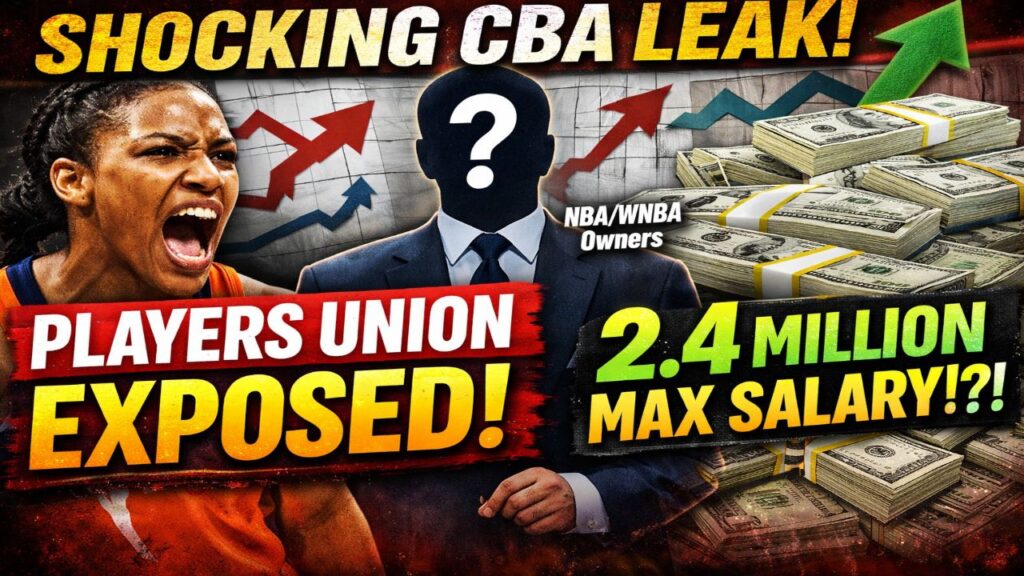
By the end of the deal, the proposed supermax salary doesn’t just increase. It explodes. From roughly a quarter million dollars today to over two point four million dollars per season. Let that sink in. That’s nearly ten times the current supermax salary. Not for one year. Not as a fluke. As a built-in outcome if growth benchmarks are met.
The average salary under that same scenario? Around one million dollars per year. For the average player. Not the stars. Not the faces of the league. The average roster spot. That’s not catching up. That’s leapfrogging decades of historical norms in women’s professional sports.
And yet… the Players Union turned it down.
That’s the part that stopped a lot of fans in their tracks.
Because once this leaked, the conversation changed overnight. Suddenly, it wasn’t about owners being cheap. It wasn’t about players being underpaid in perpetuity. It became about expectations versus reality. About risk versus reward. About whether the players truly believe in the growth narrative they’ve been selling to the public.
And that question hit hard.
If the league really is growing at an “enormous rate,” as we keep hearing, then this deal should have been a no-brainer. Because it rewards growth directly. It says, “If the league grows, you grow. If the money comes in, it goes to you.” That’s the entire structure. It aligns incentives. It protects against another financial collapse. And it still dramatically raises salaries even in the baseline scenario.
So why the resistance?
The answer seems to lie inside the fracture that emerged during the Players Association meeting itself. Because this wasn’t a united front. This wasn’t players standing shoulder to shoulder. This was a split room. One group willing to strike. Another group very clearly not wanting to burn the house down.
And that internal division matters more than anything else.
When reports surfaced that not even all top players showed up in person for such a critical meeting, fans noticed. When some stars skipped attendance due to weather while others made the trip without issue, fans noticed. When leadership admitted the meeting “set a tone” because the league didn’t budge off its proposal, fans noticed. Because tone matters. Optics matter. Especially when you’re asking the public to stand with you.
And then came the optics nightmare.
Details from the proposal didn’t just include salary figures. They included benefits. Perks. Concessions. Some serious, some almost comically small. And when fans saw items like free league pass subscriptions, complimentary All-Star tickets, and the elimination of marijuana testing listed alongside million-dollar salary projections, it didn’t land the way the union probably hoped.
Instead of looking empowering, it looked out of touch.
Because to the average fan — especially fans who work regular jobs, who don’t have guaranteed contracts, who don’t have unions negotiating on their behalf — it started to feel less like a fight for fairness and more like a fight for perfection. And perfection is a dangerous thing to demand when the business you’re part of has never turned a profit.
That’s the uncomfortable truth sitting under all of this.
The WNBA has never been profitable as a standalone league. Not once. It has survived because of subsidies, partnerships, and long-term investment from the NBA. That doesn’t mean players shouldn’t be paid well. It does mean financial reality cannot be ignored. And the owners’ proposal acknowledges that reality while still offering historic upside.
That’s why this leak hurt the Players Union so badly.
Because now fans are asking the question out loud: if this isn’t enough, what is? If a potential two point four million dollar supermax isn’t acceptable, what number would be? If an average salary nearing seven figures doesn’t satisfy, what exactly is the end goal?
And maybe the most uncomfortable question of all: do the players actually believe the league will grow enough to justify their demands?
Because rejecting a growth-based deal implies doubt. It implies mistrust in the very narrative that’s been pushed so aggressively. You can’t tell fans the league is exploding while telling owners you don’t trust the growth projections. Those two positions cannot coexist for long.
And this is where the strike talk becomes dangerous.
A strike doesn’t punish owners nearly as much as people think. Owners can wait. Owners have diversified income. Owners have other teams, other investments, other revenue streams. A strike punishes momentum. It punishes casual fans. It punishes sponsors. It punishes broadcasters. And in a league still fighting for permanent cultural footing, that risk is massive.
Especially when the deal on the table already represents the most aggressive salary growth path in league history.
This is why the public sentiment turned so fast.
Because once people saw the numbers, once they saw the structure, once they saw that the league wasn’t saying “no” but saying “prove it and we’ll pay you,” the moral high ground shifted. Suddenly, the owners didn’t look unreasonable. Suddenly, the players didn’t look unified. Suddenly, the strike threat looked less like leverage and more like self-sabotage.
And that’s the danger zone.
This moment could have been framed as a victory. As proof that the league is entering a new era. As evidence that patience plus growth equals generational wealth for players. Instead, it became a public relations mess where jokes about free tickets and league pass overshadowed historic salary projections.
That’s not where you want to be.
Because once fans start laughing instead of rallying, the battle is already lost.
The truth is, this proposal exposed a gap between public messaging and private belief. It showed that while everyone agrees growth is happening, not everyone agrees it’s sustainable. And sustainability is everything when you’re negotiating a multi-year deal with exponential financial implications.
If the league does grow at five percent annually, this deal makes players rich by any historical standard. If it doesn’t, the owners aren’t locked into obligations that could sink the entire operation. That’s not greed. That’s risk management.
And fans understand risk management. Especially in 2026. Especially after watching businesses collapse from overextending based on hype instead of fundamentals.
That’s why this leak hit different.
It wasn’t just numbers on a slide. It was a mirror held up to the entire conversation around the WNBA. And what it reflected wasn’t oppression or exploitation — it was hesitation, division, and a disconnect between expectation and reality.
The Players Union now faces a crossroads. They can recalibrate, reframe, and negotiate within the structure of growth. Or they can push forward with a strike narrative that many fans are no longer emotionally invested in supporting.
And that choice will define the league’s trajectory more than any single player, any single season, or any single headline.
Because momentum is fragile.
And once it’s gone, no salary projection in a PowerPoint can bring it back.
This was supposed to be the moment everything aligned. Instead, it became the moment the curtain was pulled back. And once fans saw what was actually on the table, the story changed forever.
The question now isn’t whether the league can grow.
The question is whether everyone involved is willing to let it.
Also Read: Latest Trending News